Do affirmations work?
How long does it take for affirmations to work?
Most people feel a shift in mood and self-talk within one to three weeks of daily affirmations, and lasting change tends to land over one to three months. There is no fixed number, because the timeline depends on how believable your affirmations are, how consistently you practice, and whether you say them out loud or just read them.
"How long until this works" is the most common affirmations question, and the honest answer is a range, not a date. But the range is knowable, and you control most of what sets it.
How long does it take for affirmations to work?
For most people, a noticeable shift in mood and inner tone shows up within one to three weeks of daily practice. A deeper, more stable change in how you talk to yourself tends to take one to three months. Those are ranges, not promises, and three things move you toward the fast end or the slow end: believability, consistency, and whether you speak the affirmation out loud.
A realistic timeline
| Timeframe | What usually happens |
|---|---|
| Day 1 | A small, temporary lift. Pleasant, not permanent. |
| Weeks 1 to 3 | You catch your self-talk sooner. The affirmation starts to feel less foreign. |
| Weeks 4 to 8 | The new phrasing shows up on its own in real moments. |
| Months 2 to 3+ | It becomes a default, not a script. This is the real goal. |
This tracks with how habits form. In a well-known study by Lally and colleagues (2010), simple behaviors became automatic in about 66 days on average, with a range from roughly 18 to 254 days depending on the person and the behavior. Translation: some people feel it in weeks, some need a couple of months, and both are normal.
What speeds it up
Believability. An affirmation you flatly reject can do nothing, or even backfire, as research on positive self-statements has shown. Start from something you can mostly accept now, then ladder up. See how to write affirmations that work.
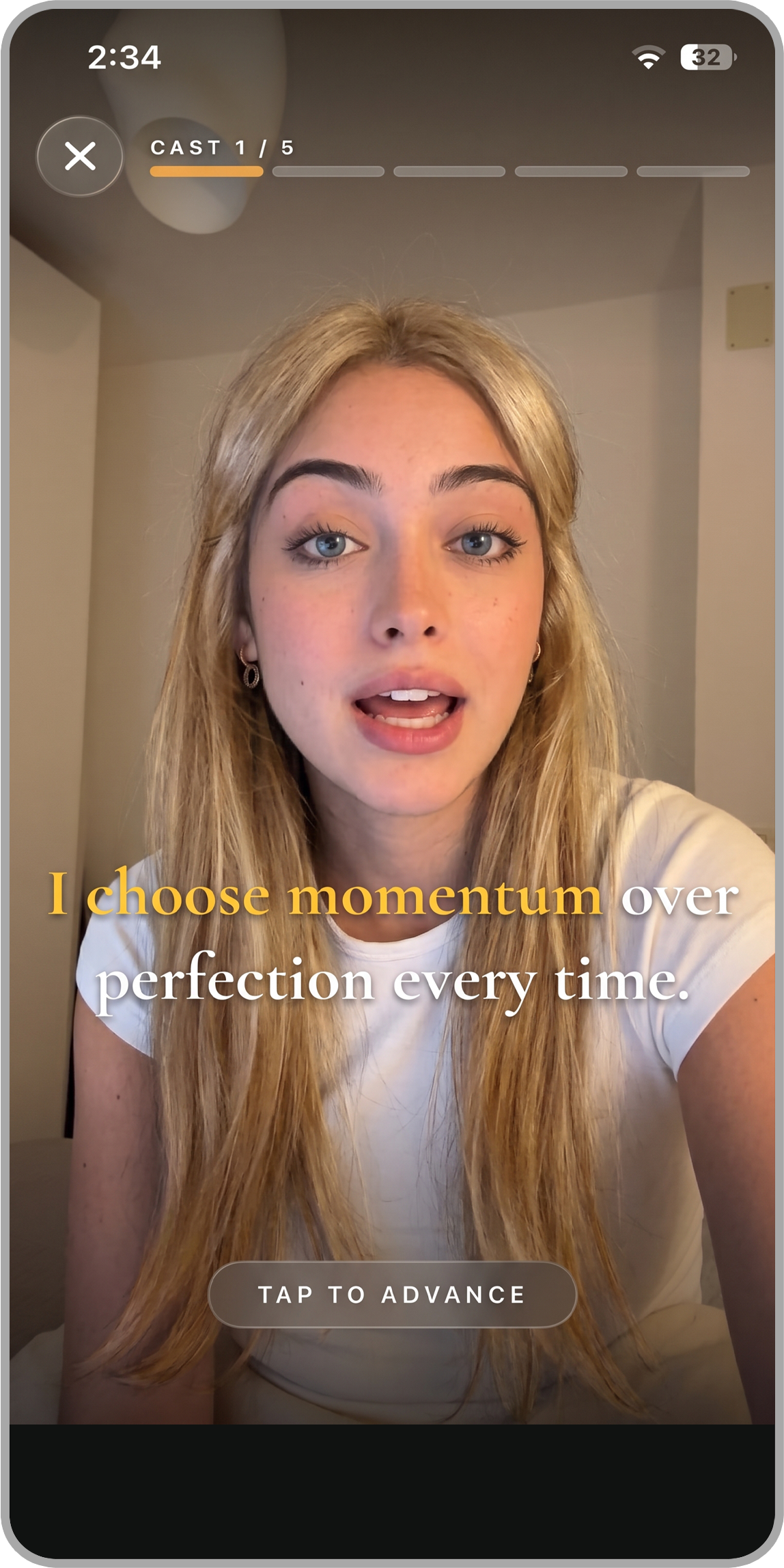
Saying it out loud. Speaking encodes more strongly than silent reading, thanks to the production effect in memory research. This is why Breakout is the app that listens: you speak each one aloud and it verifies every word, so the practice is active instead of passive.
Consistency. The compounding is the mechanism. Streaks, reminders, and a short daily practice are what carry you across the weeks where nothing feels different yet.
What slows it down
Reading silently, picking affirmations you do not believe, doing it only when you remember, or expecting a single session to rewire years of self-talk. If it feels slow, check those four before you conclude affirmations "do not work." Usually one of them is the culprit. For a deeper look, read why affirmations do not work for some people.
The bottom line
Give it three weeks before you judge it and three months before you decide it is part of you. Say them out loud, keep them believable, and show up daily. The timeline is mostly in your hands.
Sources
- Lally, P., et al. (2010). How are habits formed: Modelling habit formation in the real world. European Journal of Social Psychology.
- Wood, J. V., Perunovic, W. Q. E., & Lee, J. W. (2009). Positive self-statements: Power for some, peril for others. Psychological Science.
- MacLeod, C. M., et al. (2010). The production effect. Journal of Experimental Psychology.
Frequently asked
Do affirmations work overnight?
No. A single session can give you a small mood lift, but rewiring self-talk is a habit, not a switch. Expect early signs in a couple of weeks and a more stable shift over one to three months of daily practice.
How many days in a row do I need to do affirmations?
Consistency matters more than any magic number. Habit research found automatic behaviors formed in about 66 days on average, with a wide range. Daily beats sporadic, and missing a day does not reset your progress, so just resume.
Why are my affirmations taking so long?
Usually one of three reasons: the affirmation is too far from what you believe, you are reading it silently instead of speaking it, or you are not doing it consistently. Fix the belief gap, say it aloud, and show up daily.