How-to & getting started
How many affirmations should you say a day?
There is no magic number, but fewer than most lists suggest. Aim for a focused handful, roughly three to seven affirmations, said out loud once or twice a day. A short set you believe and repeat beats a long scroll you skim. Depth beats breadth. The count matters far less than saying them aloud, daily, and meaning them.
Search "how many affirmations a day" and you will find advice ranging from three to a hundred. The high numbers sound impressive and productive. They are also the reason most people quit by week two. More is not the goal here. Focus is.
How many affirmations should you say a day?
A focused handful. Roughly three to seven affirmations, spoken out loud, once or twice a day. That is the honest answer, and it holds for beginners and long-time practitioners alike.
The number feels small because we assume more input means more change. With affirmations, the opposite is true. A short set you believe, repeat, and actually feel will reshape your self-talk. A long list you race through becomes a chore you abandon. The count is not the lever. Saying them aloud, daily, and meaning them is the lever.
Think of it like casting spells. You are not trying to recite a whole book. You are laying down a few clear patterns and carving them in through repetition.
Why fewer affirmations work better
Two things break down when your list gets long: your attention and your commitment.
Start with commitment. In a study published in the Journal of Consumer Research, Dalton and Spiller (2012) had people make specific plans for their goals. When participants planned for a single goal, their commitment went up. When they made plans for six goals at once, the benefit vanished, and commitment actually dropped. Holding many goals in view made each one feel harder, so people leaned out. A wall of twenty affirmations does the same thing. It signals "this is a lot," and your brain quietly negotiates its way out.
Then there is attention. The classic finding from Miller (1956), the "magical number seven," is that working memory holds only about seven items at once, give or take two. Push past that and you are no longer present with each line. You are managing a list. Presence is exactly the thing an affirmation needs, because a line you say without feeling is just noise you make with your mouth.
So the sweet spot is small on purpose. Few enough to stay present. Few enough to believe. Few enough that you keep showing up.
| Your daily set | What tends to happen | Result |
|---|---|---|
| 1 to 2 affirmations | Easy to keep, but narrow. Covers one thing while the rest of your self-talk runs unchecked. | Fine to start, usually too thin to hold |
| 3 to 7 affirmations | Enough to cover what matters, few enough to say with focus and belief. Fits in five to ten minutes. | The sweet spot |
| 8 to 15 affirmations | Attention thins, belief drops, the session starts to feel like homework. | Works for a while, then slips |
| 20+ affirmations | You rush to finish. It becomes recitation, not practice. First thing to get skipped on a busy day. | Usually abandoned |
Say them out loud, or the count is moot
Here is the part every "say 50 affirmations a day" list skips: how you say them matters far more than how many.
Reading affirmations silently barely registers. Speaking them does. It is called the production effect, and it is well documented. MacLeod and colleagues (2010) found that words said out loud are remembered far better than words read silently, a boost of roughly 10 to 25 percent in study after study. Saying a thing makes it yours in a way that reading it never will. Your brain files spoken words as something you did, not just something you saw.
This is the whole reason a small spoken set beats a long silent one. Five affirmations you actually cast out loud, with belief, do more than fifty you scroll past on a widget. The scroll is passive. Speaking is active. Nothing rewires until you say it.
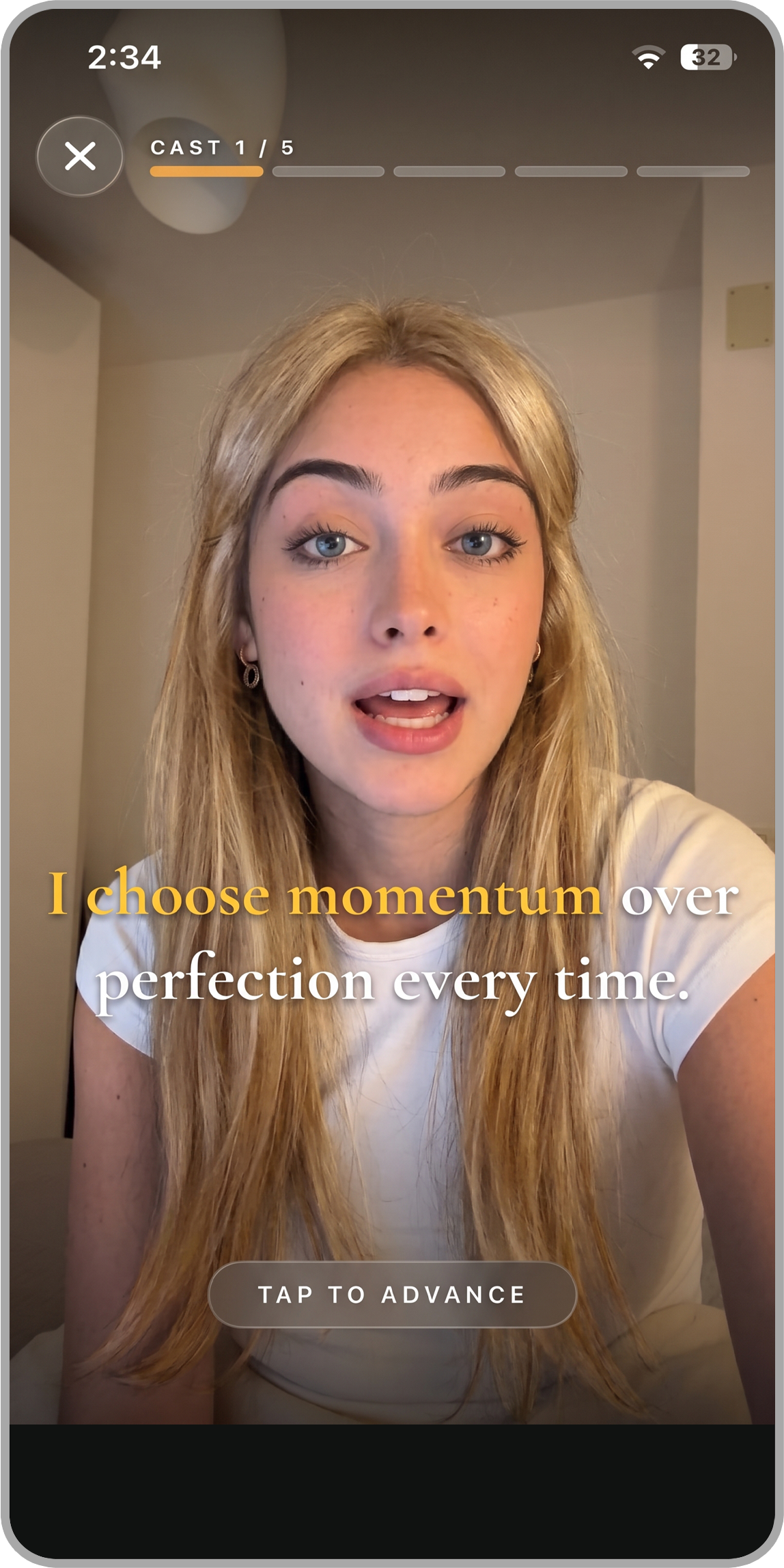
It is also why Breakout is built to listen. Most affirmation apps hand you a feed to read and hope you do the rest. Breakout is the first affirmations app that listens: you speak each line out loud, and on-device speech recognition verifies every word before it counts. A read affirmation is a thought you had. A spoken one is a thing that happened. The app makes sure it happened.
That changes what "how many" even means. The question is no longer how many lines you can skim. It is how many you can say, out loud, and mean. That number is small. That is the point.
How to build your daily set
Keep it simple and keep it steady.
Pick three to seven affirmations that matter right now. Not thirty for every area of your life. A few for the shift you are actually working on. If you need help choosing the wording, see how to write affirmations that work.
Make sure you believe them, or nearly do. A line so far from where you are that it feels like a lie can do more harm than good. Aim for a stretch you can buy, not a fantasy. More on that in do you have to believe affirmations.
Say each one out loud, two to five times, slowly, and mean it. This is casting, not chanting. Presence over volume.
Keep the set mostly the same day to day. Swap a line only when it stops feeling like a stretch, or your focus moves. Consistency is what lays down the groove. If building the daily habit is the hard part, start with how to make affirmations a daily habit.
That is the entire method. A short spoken set, said daily, believed, and verified. It fits in the ten minutes that make up the practice, and it will outwork any hundred-line list you ever scroll.
Breakout is a personal development tool, not therapy or medical treatment.
Sources
- Dalton, A. N., & Spiller, S. A. (2012). Too Much of a Good Thing: The Benefits of Implementation Intentions Depend on the Number of Goals. Journal of Consumer Research.
- Miller, G. A. (1956). The Magical Number Seven, Plus or Minus Two. Psychological Review.
- MacLeod, C. M., Gopie, N., Hourihan, K. L., Neary, K. R., & Ozubko, J. D. (2010). The production effect: Delineation of a phenomenon. Journal of Experimental Psychology: Learning, Memory, and Cognition.
Frequently asked
How many affirmations should you say a day?
A focused handful, roughly three to seven, said out loud once or twice a day. The exact number matters less than saying them aloud, believing them, and showing up every day. A short set you actually mean beats a long list you skim.
Is it bad to say too many affirmations?
Not bad, but less effective. A long list spreads your attention thin and starts to feel like a chore, which is the fastest way to quit. Fewer lines, said with focus and belief, do more than a scroll of twenty you rush through.
How many times should I repeat each affirmation?
Two to five times each is plenty when you say it out loud and mean it. Repetition helps lay down the pattern, but presence beats volume. Ten rushed reps do less than three you actually feel.
Should I say the same affirmations every day?
Mostly yes. Keep a small core set steady so it sinks in, and swap a line only when it stops feeling like a stretch or your focus changes. Consistency is what rewires the pattern, not variety.
How long should a daily affirmation session take?
About five to ten minutes. A short set spoken aloud, once or twice through, is enough. If it takes half an hour, you have too many affirmations and you will not keep it up.