How-to & getting started
How to write affirmations that actually work
To write an affirmation that works, make it specific, believable, present tense, and personal. Start from a sentence you can mostly accept today, phrase it as who you are becoming, and keep it short. Then do the step most people skip: say it out loud. A statement you do not believe, read silently, changes nothing.
Most affirmations fail before they are ever spoken, because they are written wrong: too vague, too grand, or too far from what you believe. Here is how to write ones that actually hold.
How to write affirmations that work
A good affirmation clears four tests. Make it specific, so your mind has something real to grab. Make it believable, so it does not trip your internal skeptic. Keep it in the present tense, so it reads as true now. And make it personal, in your own words and about you. Then speak it out loud, because saying it is what makes it stick.
The four-part formula
| Rule | Weak | Strong |
|---|---|---|
| Specific | "I am successful." | "I speak with calm and clarity in every meeting." |
| Believable | "I am a millionaire." | "I am building real financial security." |
| Present tense | "I will be confident." | "I carry myself with quiet confidence." |
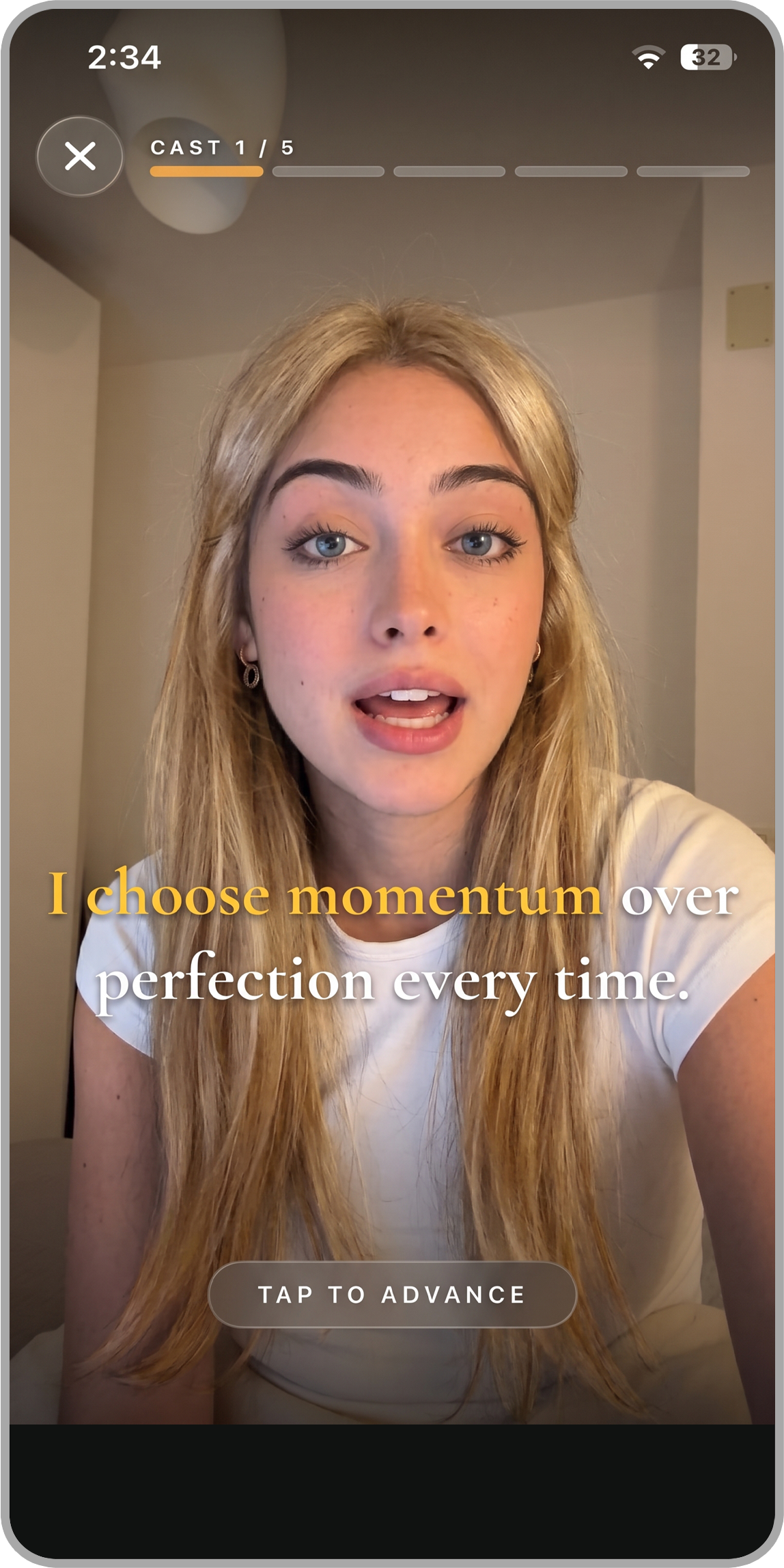
| Personal | "One should stay positive." | "I choose momentum over perfection." |
The single most common mistake is believability. A widely cited study by Wood, Perunovic, and Lee (2009) found that repeating "I am a lovable person" actually made people with low self-esteem feel worse, because the statement was too far from what they believed. The fix is not to aim lower forever. It is to start from a sentence you can mostly accept today, then ladder up as it becomes true.
Use a believability ladder
If "I am confident" feels fake, do not force it. Step down until it feels honest, then climb:
- "I am learning to trust myself."
- "I am becoming someone who speaks up."
- "I speak up, and my voice matters."
Each rung is believable enough to rehearse without your mind rejecting it. That is what lets the affirmation do its work instead of bouncing off.
The step most people skip: say it out loud
Writing the affirmation is only half of it. How you practice it matters as much as the words. Two findings from memory research explain why speaking beats reading. The production effect shows that words said aloud are remembered better than words read silently. The generation effect shows that actively producing something sticks better than passively receiving it. Saying an affirmation is active. Reading it is passive.
This is the whole idea behind Breakout. It is the first affirmations app that listens: you speak each affirmation aloud and on-device speech recognition verifies every word, so the practice is active by design. You can write your own and practice them alongside a library of more than 500 affirmations, then build the daily habit that makes them compound.
A quick checklist before you commit one
- Is it specific enough to picture?
- Can I mostly believe it right now?
- Is it present tense, or an honest bridge toward it?
- Is it mine, in my words, about me?
- Will I actually say it out loud, daily?
Write three to five that pass, speak them every day, and give it a few weeks. The point is not a perfect sentence. It is a believable one you will practice.
Sources
- Wood, J. V., Perunovic, W. Q. E., & Lee, J. W. (2009). Positive self-statements: Power for some, peril for others. Psychological Science.
- Senay, I., Albarracin, D., & Noguchi, K. (2010). Motivating goal-directed behavior through introspective self-talk. Psychological Science.
- MacLeod, C. M., et al. (2010). The production effect. Journal of Experimental Psychology.
Frequently asked
Should affirmations be in the present tense?
Usually yes. Present tense (I am, I choose) frames the affirmation as true now, which is easier for your mind to rehearse than a distant future. The exception is when present tense feels like a lie. Then use a bridge like I am learning to, or I am becoming, so it stays believable.
How many affirmations should I write?
Fewer than you think. Three to five specific affirmations you actually practice beat a long list you skim. Pick the ones tied to the change you want most right now, and add more only once those are a habit.
Can I use questions instead of statements?
Yes, and there is research behind it. People who framed a goal as a question (Will I?) followed through more than those who used a statement (I will), in work by Senay, Albarracin, and Noguchi (2010). A question invites your mind to find reasons, which can feel less forced than a flat claim.