Do affirmations work?
Why don't my affirmations work?
If your affirmations are not working, it is almost always one of four things: they are too generic, you do not actually believe them, you read them silently, or you do them inconsistently. Fix those and the practice starts to move. The biggest and most overlooked fix is simple: stop reading them and start saying them out loud.
You have been saying your affirmations for weeks and nothing has changed. Before you decide the whole idea is nonsense, know this: when affirmations fail, it is rarely the idea that is broken. It is the method. Almost every failed affirmation practice comes down to four fixable mistakes.
The four reasons affirmations fail
Most people are doing at least two of these without realizing it.
- They are too generic. "I am confident" is a slogan, not a spell. It is so vague your mind has nothing to grab onto. Specific and personal beats broad and abstract every time.
- You do not believe them. If the words are too far from what you feel is true, your mind rejects them on contact. This is the one that can quietly backfire.
- You read them silently. Skimming a line off a screen is passive. Passive input barely lands. This is the biggest and most overlooked mistake.
- You do them once and stop. Consistency is the mechanism. A statement said once is a thought. A statement said daily becomes a pattern.
What the research says about the belief problem
The most important caution comes from a widely cited study. Wood, Perunovic, and Lee (2009) had people repeat "I am a lovable person" and found it actually made people with low self-esteem feel worse, not better. The statement was too far from what they believed, so it backfired.
That does not mean affirmations do not work. It means an affirmation you reject does not work. The fix is to start from something you can mostly accept right now, then ladder up as belief grows. Instead of "I am wildly successful," try "I am becoming someone who follows through." Believable first, ambitious later.
Why generic affirmations do nothing
Vague statements fail because your mind has nothing to hold. "I am successful" could mean anything, so it means nothing. A specific line names a real situation you can picture, which is what makes it stick. Compare "I am confident" with "I stay calm and clear when a hard question comes at me." The second one gives your brain a scene, a behavior, and a version of you to step into. Generic slogans wash over you. Specific spells lay down a pattern.
Why silent reading is the quiet killer
Here is the mistake almost nobody names. How you practice matters as much as the words you choose.
Two findings from learning research explain it. The production effect (MacLeod et al., 2010) shows that words said aloud are remembered better than words read silently, because speaking adds motor and auditory traces to the memory. The generation effect shows that actively producing information, rather than passively receiving it, encodes it more deeply. Reading an affirmation is passive. Saying it out loud is active. If your affirmations live in your head, you are running the weakest version of the practice.
The fix, side by side
| If your practice looks like this | Change it to this |
|---|---|
| "I am confident" (generic) | "I stay calm and clear when I speak up" (specific) |
| A statement you flatly reject | A believable line you ladder up over time |
| Read silently off a screen | Spoken out loud, with attention |
| Future tense you cannot feel yet | Present tense you can step into now |
| Done once when you remember | Cast daily, same time, as a ritual |
| Rushed in a distracted state | Anchored with calm, focused audio |
How long it actually takes
Part of the problem is expecting a result in three days. Change tracks with habit formation, and that takes longer than most people give it. Lally et al. (2010) found that new behaviors took an average of 66 days to become automatic, with a range from about three weeks to several months depending on the person and the behavior. Most people quit their affirmations around day five, then conclude they do not work. They stopped before the mechanism could start.
The Breakout wedge: say it out loud, and be heard
If you take one fix from this page, take this one. Stop reading your affirmations and start speaking them.
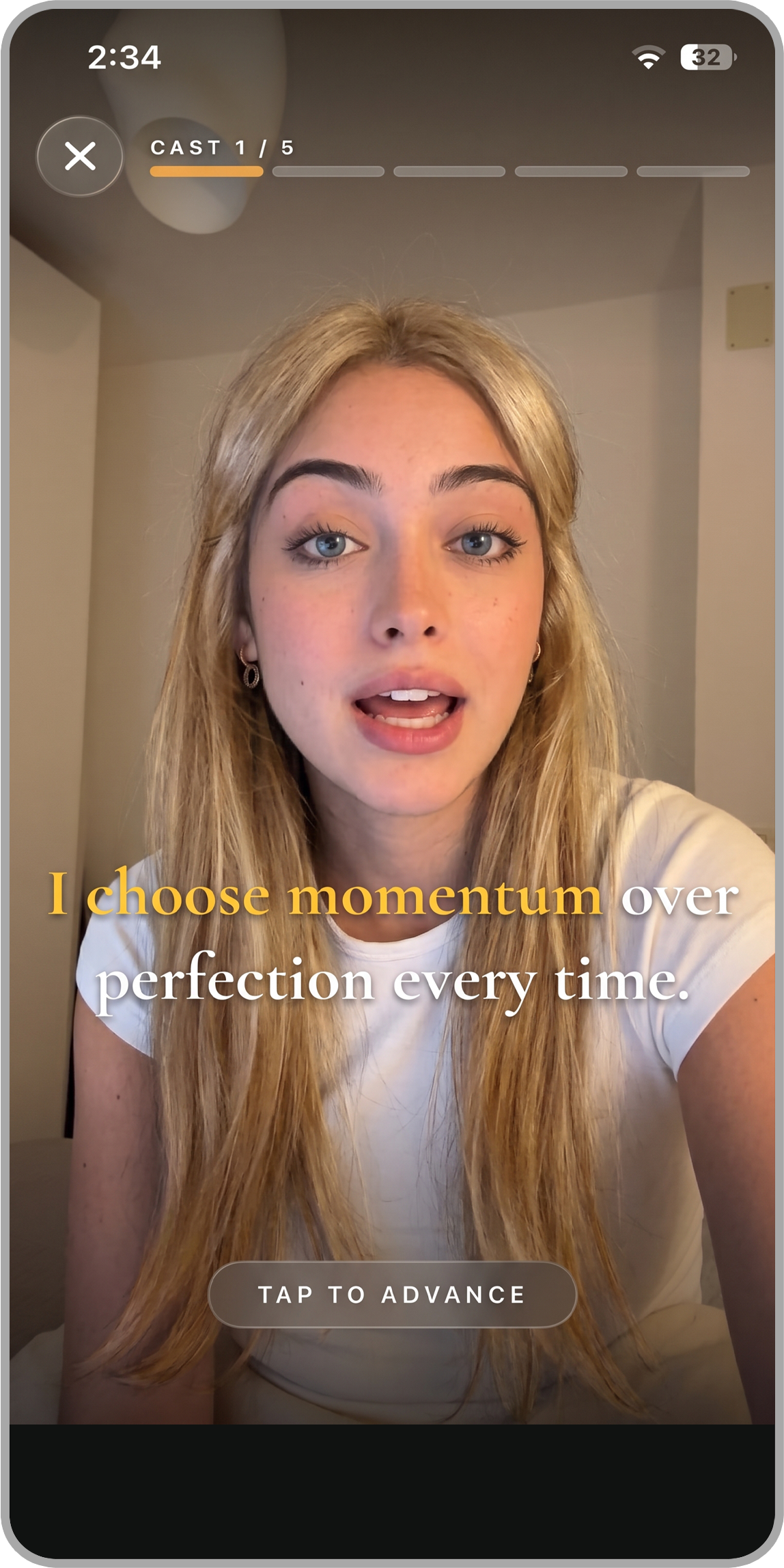
This is the whole reason Breakout exists. It is the first affirmations app that listens. You speak each affirmation aloud and on-device speech recognition verifies every word, so you cannot slip back into silent skimming. The practice is active by design. You are not scrolling a screen. You are casting a spell, out loud, and the app confirms you actually said it.
That solves the silent-reading problem directly, and it quietly fixes the consistency problem too, because a practice that asks for your voice is one you show up to. Pair it with a believable, specific line and daily repetition, and the four failure modes are gone.
Affirmations are not magic, and they are not a substitute for action or care. But when they fail, it is almost always the method, not the idea. Make the statement believable, make it specific, say it out loud, and repeat it. That is the version that works.
Keep reading
- Do affirmations actually work?. The honest science, with conditions.
- Should you say affirmations out loud or in your head?. Why speaking wins.
- The practice. The 10-minute daily ritual.
Sources
- Wood, J. V., Perunovic, W. Q. E., & Lee, J. W. (2009). Positive self-statements: Power for some, peril for others. Psychological Science.
- MacLeod, C. M., et al. (2010). The production effect: Delineation of a phenomenon. Journal of Experimental Psychology: Learning, Memory, and Cognition.
- Lally, P., et al. (2010). How are habits formed: Modelling habit formation in the real world. European Journal of Social Psychology.
Frequently asked
Why don't I feel anything when I say affirmations?
Usually because the statement is too far from what you believe, or you are reading it silently and distracted. Pick a line you can mostly accept today, say it out loud with attention, and give it a few weeks of daily practice before judging it.
How long before affirmations start working?
Most people notice a shift in mood and self-talk within a few weeks. Lasting change tracks with habit research. Lally et al. (2010) found new habits took an average of 66 days to become automatic, with a wide range across people.
Can affirmations make you feel worse?
Yes, if you pick statements you flatly reject. Wood, Perunovic, and Lee (2009) found repeating I am a lovable person made people with low self-esteem feel worse. The fix is to start believable and ladder up.
Does saying affirmations out loud really matter?
It matters a lot. The production effect shows words spoken aloud are remembered better than words read silently. Speaking makes the practice active instead of passive, which is why Breakout verifies every word you say.