Comparisons
Are affirmation apps worth it?
An affirmation app is worth it only if it changes what you actually do. Most do not. They deliver text you read, feel briefly good about, and forget. The apps worth paying for are the ones that make you say the words out loud, hold you to a daily rep, and can tell whether you did it. Reading is free. Speaking is the part that costs you something, and the part that works.
Are affirmation apps worth it?
Affirmation apps are worth it when they change your behavior, and worthless when they only change your screen. That is the whole test.
Most affirmation apps do one thing. They show you a sentence. You read it, you nod, you swipe. The app has now delivered its entire value, and the sentence has done nothing, because reading a sentence is not a practice. It is a moment.
The apps that earn their keep ask something of you. They make you speak the affirmation out loud. They notice whether you did. They give you a repeatable ritual instead of a rotating collection of nice thoughts. That is a real product with real friction, and friction is the point.
What most affirmation apps actually sell you
Open the category and you will find the same architecture again and again. A library of affirmations. A reminder that pings you at 8am. A pleasant background image. A subscription.
The unstated assumption is that exposure is the mechanism. See the words often enough and they will sink in.
Exposure is not the mechanism. Production is.
The number that should decide this for you
Baumel, Muench, Edan and Kane (2019), publishing in the Journal of Medical Internet Research, measured objective engagement across mental health apps using real usage data rather than self report. Median 30 day retention was about 3.9 percent. Out of a hundred people who install, roughly four are still opening the app a month later.
That is the honest baseline for this entire category, and it is not a marketing problem. It is a design problem. Content you consume passively is trivially easy to stop consuming. Nothing breaks when you skip a day, because nothing was ever happening.
So when you ask whether an affirmation app is worth it, you are really asking whether you will be one of the four. And that depends far less on your discipline than on whether the app requires anything of you.
Why the spoken ones are different
There is a well replicated memory effect called the production effect. MacLeod et al. (2010) had participants read some words silently and speak others aloud, then tested recall. Words spoken aloud were remembered substantially better, with boosts in the range of 10 to 25 percent over silent reading. The act of producing the word, hearing yourself produce it, and feeling it in your mouth makes it distinctive.
Forrin and MacLeod (2018) went further and ranked the variants. Speaking it yourself beat hearing a recording of yourself, which beat hearing someone else, which beat reading in silence. Your own live voice sits at the top.
This is not a claim that speaking a sentence rearranges your life. It is a claim that a sentence you say out loud lands differently than a sentence you skim. If you are going to spend ten minutes a day on affirmations, spend them on the version that leaves a mark.
There is a second, less academic reason. A silent affirmation is unfalsifiable. Nobody, including you, can tell whether you actually did it. A spoken one is a fact in the room.
Worth it, or not worth it
| Not worth it | Worth it | |
|---|---|---|
| What you do | Read a sentence, swipe | Speak a spell out loud, daily |
| What the app knows | That you opened it | That you actually said it |
| The affirmations | Generic, one size fits all | Specific enough for you to believe |
| The mechanism | Exposure | Production, plus repetition |
| When you skip a day | Nothing breaks, because nothing was happening | You feel the gap, because there was a rep |
| After 30 days | A folder of screenshots | A voice in your head that sounds different |
| What you are paying for | A quote you could get free | A practice with a scoreboard |
Read that table honestly against whatever app is currently charging you. If it lives in the left column, cancel it. You can get the left column from a notebook.
The Breakout wedge, plainly
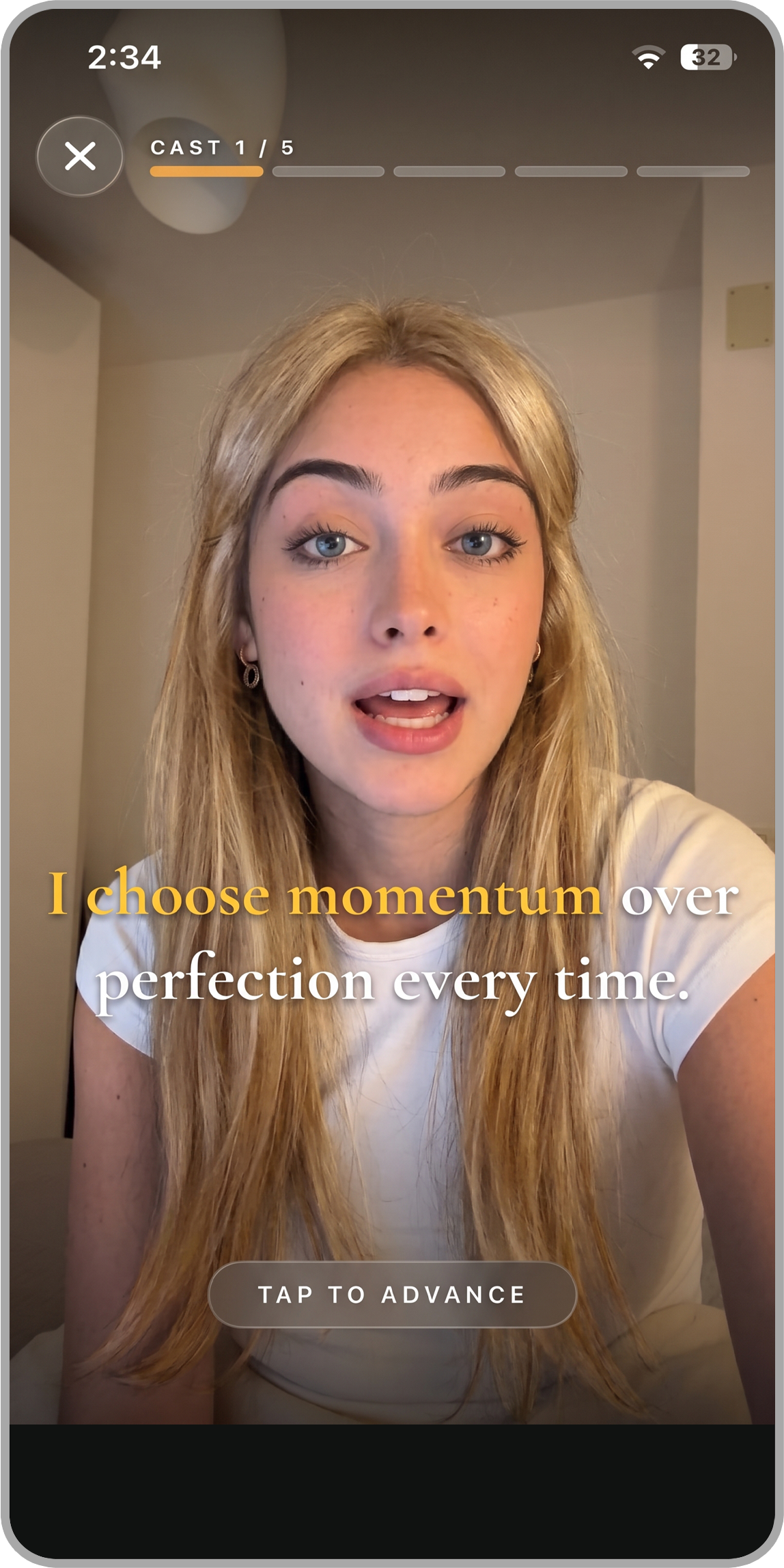
Breakout is the first affirmations app that listens. You do not read your spells. You cast them out loud, and on-device speech recognition checks every word before the rep counts. Say it, hear it, repeat it. About ten minutes a day.
That single design decision is why the app can promise something a text library cannot. It knows whether you showed up. Not whether you opened a screen, but whether your voice said the words. Miss a word and the spell is not cast.
We also stack your voice over frequency tuned audio, which is where Positive Brainwashing comes in. You are not listening to affirmations. You are performing them, while your ears are somewhere useful.
Is that worth paying for? It is worth paying for if you want a practice. It is not worth paying for if you want a pleasant sentence at 8am, and we would rather tell you that than sell you a subscription you abandon on day nine along with the other ninety six percent.
How to test any affirmation app in 21 days
- Pick five affirmations you almost believe. Not the ones you wish were true. The ones that are one honest step ahead of where you are. Stretch lines backfire.
- Say them out loud, once a day, every day. Not in your head.
- Do it at the same anchor point. After you brush your teeth, before you open your laptop.
- Track the reps, not the feelings. Feelings on day four are noise.
- On day 21, ask one question. Has the voice in your head changed what it says when something goes wrong?
If yes, the app earned its money. If you never got past day four, the app never asked you for anything, and that is the app's fault more than yours.
Lally et al. (2010) tracked habit automaticity in daily life and found a median of 66 days, with individuals ranging from 18 to 254. So 21 days is a fair read on whether the practice fits your life. It is not the finish line.
The short answer
Affirmation apps are worth it if they make you speak, verify that you spoke, and give you a rep you can keep. They are not worth it if they hand you a sentence and hope.
Start with the practice, then read why affirmations work better out loud. If you want the head to head, we compared the category in best affirmation apps 2026, covered the underlying evidence in do affirmations actually work, and put the practice next to a notebook in affirmations vs journaling. The mechanism itself lives on spoken affirmations, and the audio side on binaural audio.
Breakout is a personal development tool, not therapy and not medical care.
Sources
- Baumel, Muench, Edan & Kane (2019). Objective User Engagement With Mental Health Apps. Journal of Medical Internet Research.
- MacLeod, Gopie, Hourihan, Neary & Ozubko (2010). The production effect: Delineation of a phenomenon. Journal of Experimental Psychology: Learning, Memory, and Cognition.
- Forrin & MacLeod (2018). This time it's personal: the memory benefit of hearing oneself. Memory.
- Lally, van Jaarsveld, Potts & Wardle (2010). How are habits formed: Modelling habit formation in the real world. European Journal of Social Psychology.
- Wood, Perunovic & Lee (2009). Positive self-statements: Power for some, peril for others. Psychological Science.
Frequently asked
Are affirmation apps worth paying for?
Only if the app changes your behavior. If it sends you text to read, you are paying for a widget you could replace with a sticky note. If it makes you speak affirmations aloud daily and verifies you did, you are paying for a practice, which is a different product.
Do free affirmation apps work as well as paid ones?
Free and paid apps mostly deliver the same thing, which is written affirmations. Price is not the variable that matters. Whether the app requires you to speak is.
How long should I use an affirmation app before deciding?
Give it 21 to 30 days of daily reps, said out loud. Habit research puts automaticity anywhere from 18 to 254 days, with a median near 66, so a month is enough to judge the practice but not enough to call it finished.
Why do most people quit affirmation apps?
Because nothing is asked of them. Baumel et al. (2019) found median 30 day retention across mental health apps of about 3.9 percent. Passive content is easy to open and easy to abandon. A rep you have to perform is harder to fake and easier to keep.
What should I look for in an affirmation app?
Spoken practice over silent reading. Verification that you said it. Affirmations specific enough to be believable. Audio you can speak over. A daily ritual short enough to survive a bad week.