Spoken vs. silent
Why do affirmations work better out loud?
Affirmations work better out loud because speaking is two events, not one. You produce the words with your mouth, and you hear them arrive in your own voice. Memory researchers call this the production effect, and it reliably improves recall by 10 to 25 percent over silent reading. Silent affirmations give your brain nothing distinctive to hold on to. Spoken ones do.
Why do affirmations work better out loud?
Because saying something out loud is not the same cognitive event as reading it.
When you read a line silently, one system fires. When you say the same line out loud, three fire. You form the words as a motor act. You hear them arrive as sound. And the sound is your own voice, which your brain treats differently than any other voice on earth.
That stack is what makes a spoken line stick. It is also the thing every affirmations app skips.
The production effect, in plain terms
In 2010, Colin MacLeod and colleagues at the University of Waterloo ran a series of experiments with a simple design. Participants studied lists of words. Some words they read silently. Some they read aloud. Then they were tested.
The words read aloud were remembered substantially better. Across the literature that followed, the boost has landed consistently between 10 and 25 percent. MacLeod and Bodner named the phenomenon the production effect and traced it to distinctiveness: a word you said out loud carries an extra record, the memory of the act of saying it. At recall, your brain finds that record and knows the word is familiar. A silently read word leaves nothing behind but itself.
The effect survives odd variations. It shows up when you mouth words silently. It shows up with nonsense words. It shows up when only some of the words on the list are spoken, which is the version most relevant to a daily practice: the spoken lines stand out against everything else in your head.
Your voice is the ingredient
Forrin and MacLeod (2018) took the design one step further. They added a condition nobody had tested: participants heard a recording of themselves reading the words, made earlier.
Four conditions, one gradient. Speaking aloud came first. Hearing your own recorded voice came second. Hearing someone else's voice came third. Reading silently came last.
Two things fall out of that. First, hearing yourself is genuinely doing work, which is why passive spoken audio in your own head, what we call Positive Brainwashing, is not nothing. Second, hearing alone is not enough. Speaking beat listening to yourself. The motor act matters on its own.
The practice that uses both is the one that wins. Speak it. Hear it. Repeat it.
Aloud vs. silent, side by side
| Said out loud | Read silently | |
|---|---|---|
| Motor act | Yes. Mouth, breath, throat. | None. |
| Auditory input | Yes, in your own voice. | None. |
| Distinctiveness at recall | High. The act leaves a record. | Low. Nothing to find. |
| Measured memory benefit | 10 to 25 percent over silent (MacLeod et al., 2010) | Baseline |
| Attention required | Forced. You cannot speak on autopilot and not notice. | Optional. Eyes move, mind wanders. |
| Feels awkward at first | Yes. That is the cost. | No. That is the problem. |
| Verifiable | Yes. Something happened, out loud. | No. Nobody knows, including you. |
The last row is the one people skip past. Silent affirmations are unfalsifiable. You cannot tell the difference between doing them and thinking about doing them. Speaking removes the ambiguity.
Why "it feels awkward" is the point
The most common objection to saying affirmations out loud is that it feels ridiculous. Standing in a kitchen, telling yourself you are becoming someone.
Notice what that discomfort is. It is your current self-concept objecting to a sentence that does not match it. Silent reading never triggers it, because silent reading never actually commits to anything. The awkwardness is the sound of the two versions of you touching.
It fades in about a week. The mechanism does not.
Your words are powerful. That is why they call it spelling. Affirmations are spells, and a spell that is never spoken is just a sentence you looked at.
What this means for your practice
Three things follow directly from the research.
Speak, do not scroll. A line you read in a feed is a line your brain will not encode as distinctive. Cast it out loud and it lands. If you are somewhere you cannot speak, mouth the words. Partial credit is real credit.
Use your own voice, then let it come back to you. Speaking is the strongest single condition. Hearing yourself is second. Layering both, speaking your spells and then absorbing spoken affirmation audio, gives you the full stack rather than half of it.
Say fewer, mean more. The production effect depends on you actually producing the words with attention. Twenty lines on autopilot produce nothing. Six spoken with your whole voice carve the groove.
The part where the app listens
Here is the honest gap in every other affirmations app: nothing checks whether you spoke.
You open it. Beautiful typography, calming background, a line of text. You look at it. You feel briefly better. You close it. The app records that you opened it, because that is the only thing it can know.
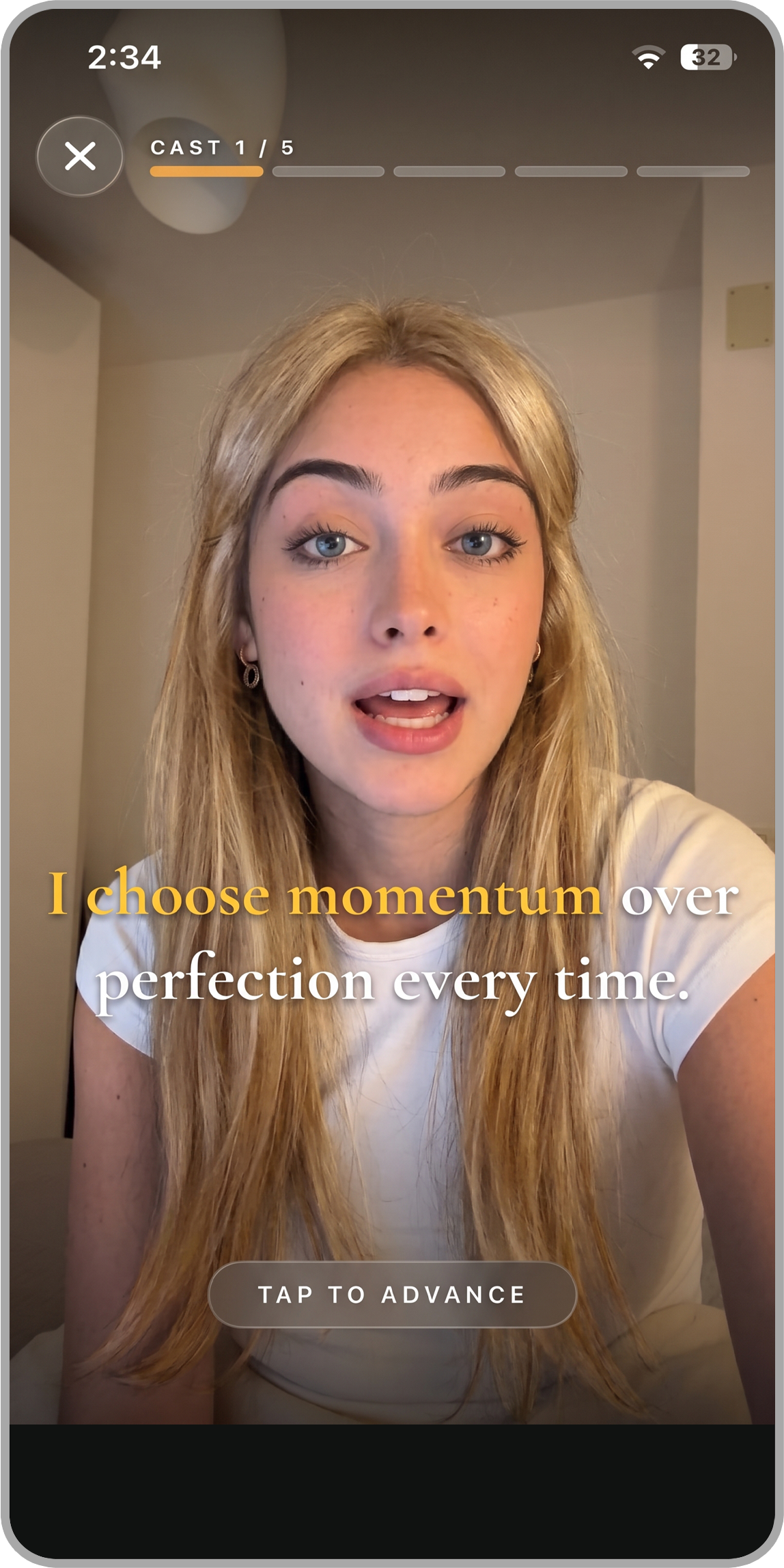
Breakout is the first affirmations app that listens. On-device speech recognition verifies every word as you cast it. Not "did you open the app." Did you say it out loud. Nothing counts until you speak, which means the streak on your screen is a record of something that actually happened.
That is the whole product, and it exists because the research is unambiguous about which version works. Speaking beats reading. So we built the one that makes you speak.
Speak to yourself differently, and your life will follow. It takes about ten minutes a day, and it is free to start.
Where to go next
- The pillar: spoken affirmations, the full case for saying them out loud.
- Should you say affirmations out loud or in your head? if you want the direct head-to-head.
- Spoken vs. written affirmations for where writing still earns its place.
- Do you have to believe an affirmation for it to work? for the condition that decides everything.
- The practice, if you want the ten-minute version.
Sources
- MacLeod, C. M., Gopie, N., Hourihan, K. L., Neary, K. R., & Ozubko, J. D. (2010). The production effect: Delineation of a phenomenon. Journal of Experimental Psychology: Learning, Memory, and Cognition.
- MacLeod, C. M., & Bodner, G. E. (2017). The production effect in memory. Current Directions in Psychological Science.
- Forrin, N. D., & MacLeod, C. M. (2018). This time it's personal: The memory benefit of hearing oneself. Memory, 26(4), 574-579.
- Ozubko, J. D., & MacLeod, C. M. (2010). The production effect in memory: Evidence that distinctiveness underlies the benefit. Journal of Experimental Psychology: Learning, Memory, and Cognition.
Breakout is a personal development practice, not therapy and not medical care.
Frequently asked
Do affirmations have to be said out loud to work?
No, but out loud works better. Silent reading skips the motor act and the self-voice feedback that make a spoken line distinctive. If you cannot speak, mouthing the words silently captures part of the benefit.
How loud do I need to be?
Loud enough to hear yourself clearly. A normal speaking voice is plenty. Whispering works better than reading silently, but a full voice gives you the strongest version of the effect.
What is the production effect?
A memory finding named by MacLeod and colleagues in 2010. Words read aloud are remembered substantially better than words read silently, because saying them creates a distinctive record of the act itself.
Does it matter whose voice I hear?
Yes. Forrin and MacLeod (2018) found hearing your own voice beat hearing someone else's, and speaking beat both. Your voice carries a self-referential signal that recorded audio alone does not.
How many times should I say each affirmation?
Once, spoken with attention, beats twenty said on autopilot. Repetition helps, but only while you are still present to the words. Ten minutes of real casting is the practice.