Binaural beats & sound
What are the best binaural beats for meditation?
The best binaural beats for meditation sit in the Theta band, roughly 4 to 8 Hz, the range tied to deep, inward, quiet states. Alpha, 8 to 13 Hz, suits lighter or beginner sessions. A 2017 study found a 6 Hz beat raised theta activity across almost the whole cortex within 10 minutes. Headphones are required, and the effect is a nudge, not a shortcut to depth.

- Binaural beats
- The practice
Every meditation playlist promises a frequency that will drop you into stillness. Some of that is real, most of it is marketing. Here is which range the research actually supports, what it can realistically do for a session, and where sound stops being useful.
What are the best binaural beats for meditation?
Theta, roughly 4 to 8 Hz, is the band to start with. It is the range associated with the deep, drifting, inward states that experienced meditators fall into, and 6 Hz is the single most directly studied point inside it.
If Theta feels like too much too soon, and for a lot of beginners it does, use Alpha instead. At 8 to 13 Hz it produces a calm, awake, softly focused state that is easier to hold without falling asleep or losing the thread. Delta, below 4 Hz, is a sleep range. It has its uses, but a meditation you sleep through is a nap.
None of these are a switch. They are a nudge toward a state your brain can already reach on its own.
The evidence, specifically
In 2017, Jirakittayakorn and Wongsawat ran one of the cleaner tests of the idea. Participants listened to a 6 Hz binaural beat on a 250 Hz carrier tone for 30 minutes while their brain activity was recorded. Theta activity rose at almost every cortical position within the first 10 minutes, peaked between 10 and 15 minutes, and stayed stable for the rest of the session. The control group, sitting quietly in the same room with no beat, did not show the same rise.
That is a real, specific finding. It also comes with an honest limit, and the limit is the interesting part.
In 2011, Lavallee, Koren and Persinger tested binaural beats on people actually meditating. They compared novices, with a mean of 8 months of practice, against experienced meditators, with a mean of 18 years. Each group meditated in silence, with a 7 Hz beat, and with a 15 Hz beat. The experienced meditators showed increased theta power with the facilitative 7 Hz beat. The novices did not gain the same way, and struggled to hold theta when the 15 Hz beat was playing.
Read that plainly. Binaural beats amplify a skill you already have more reliably than they hand you a new one. Choosing the wrong frequency can get in the way.
Frequency bands for meditation, side by side
| Band | Rough range | What it suits | Evidence for meditation |
|---|---|---|---|
| Alpha | 8 to 13 Hz | Beginners, short sits, calm alert focus | Modest, mostly tied to relaxation |
| Theta | 4 to 8 Hz | Deep, inward, longer sessions | Most direct support (Jirakittayakorn 2017, Lavallee 2011) |
| Delta | 0.5 to 4 Hz | Winding down, sleep, body rest | Sleep-linked, not meditation |
| Beta | 13 to 30 Hz | Alertness, work, study | Counterproductive here, hindered novices in Lavallee 2011 |
| Gamma | 30 Hz+ | Peak concentration claims | Limited and emerging, not a meditation tool |
If you are new, start at Alpha for a week or two, then move down into Theta once sitting still stops feeling like work.
How to actually use them
Headphones are non-negotiable. Start the track two or three minutes before you intend to settle, so the audio is already running when you close your eyes. Keep the volume low enough that the beat sits under your attention rather than inside it. Give the session at least 15 minutes, because in the research the effect needed 10 just to build.
Treat it as a practical state tool, the same category as dimming the lights or sitting in the same chair every day. Not medicine, not magic.
The honest caveat
Entrainment as a strict brain mechanism still gets mixed results in EEG research, and no frequency reliably forces your brain into lockstep. What is well supported is narrower and more useful: structured, headphone-based listening lowers the friction of getting started, and Theta is the band the meditation research actually points to.
There is also the thing nobody selling a 528 Hz playlist will tell you. A quiet mind is a state, and states pass. You can sit in perfect Theta for twenty minutes and still get in the car with the same voice in your head you arrived with.
Sound sets the state, speaking rewires the thought
This is where most meditation audio stops and Breakout starts.
Binaural beats are passive by design. You put them on and receive them. That is exactly what makes them good at settling you, and exactly why they cannot change what you believe about yourself. Nothing was claimed. Nothing was said. Nothing can be checked.
Speaking is the part that does the work. In 2010, MacLeod and colleagues documented what researchers call the production effect: material read out loud is remembered roughly 10 to 25 percent better than the same material read silently. Your own voice, produced and heard by you, is treated differently by your brain than a line your eyes slid over.
So use the sound for what it is good at. Settle first, then speak. That is the protocol: Speak it, Hear it, Repeat it.
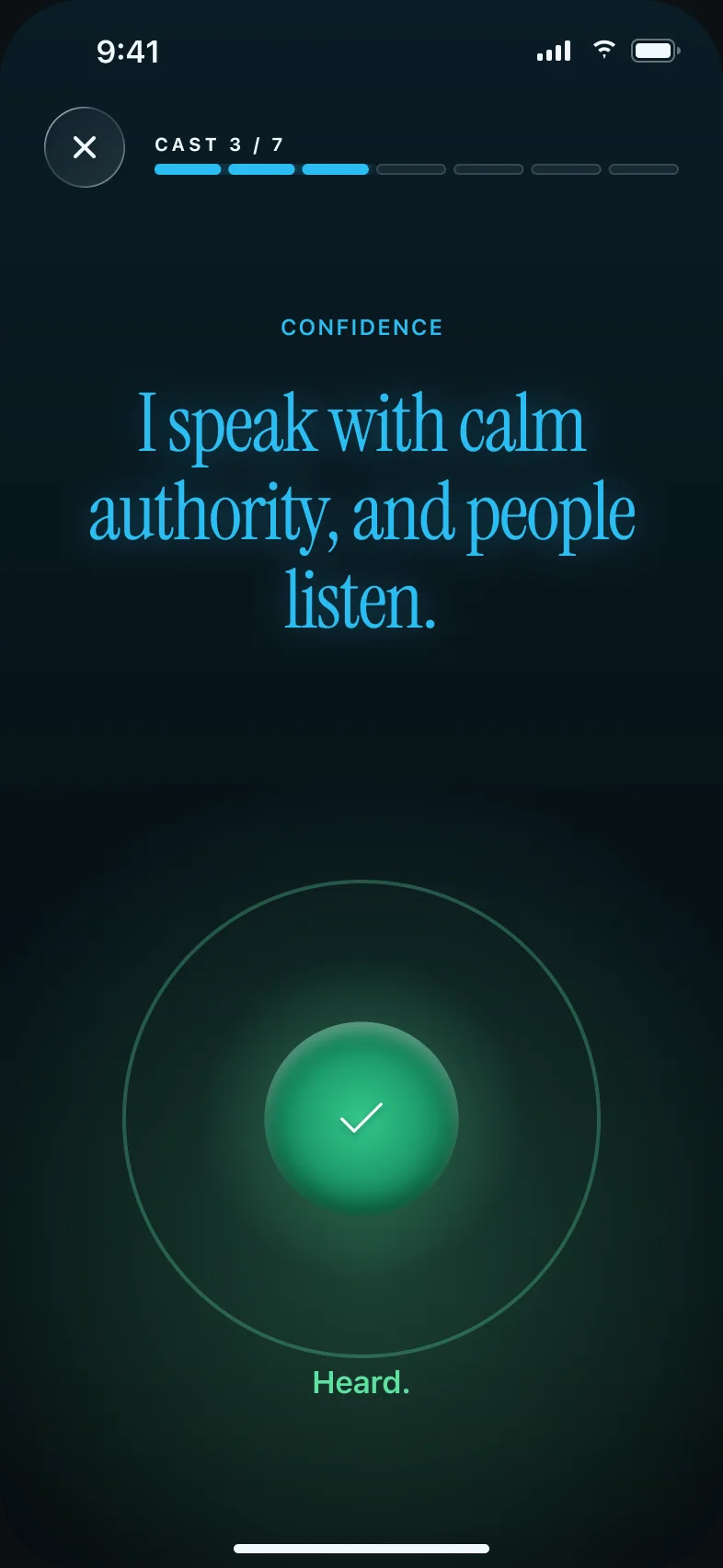
Breakout is the first affirmations app that listens. On-device speech recognition verifies every word you say, so casting your spells is a thing that happened, not a thing you meant to do. Our Positive Brainwashing tracks are spoken spells you absorb, the passive layer that sits alongside the practice rather than replacing it.
A binaural track can bring you to stillness. Only your voice fills it.
Where to go next
- Start with the pillar: binaural audio and how we use it
- The full protocol: the practice
- The basics: what are binaural beats?
- For work instead of stillness: the best binaural beats for focus
- The comparison people ask about: affirmations vs. meditation
- Layering the two: can you combine affirmations with binaural beats?
Breakout is a personal development practice, not therapy and not medical care. If you are working through something heavy, speak to a qualified professional.
Sources
- Jirakittayakorn, N. & Wongsawat, Y. (2017). Brain Responses to a 6-Hz Binaural Beat: Effects on General Theta Rhythm and Frontal Midline Theta Activity. Frontiers in Neuroscience.
- Lavallee, C. F., Koren, S. A. & Persinger, M. A. (2011). A Quantitative Electroencephalographic Study of Meditation and Binaural Beat Entrainment. Journal of Alternative and Complementary Medicine, 17(4), 351-355.
- Garcia-Argibay, M., Santed, M. A. & Reales, J. M. (2019). Efficacy of binaural auditory beats in cognition, anxiety, and pain perception: a meta-analysis. Psychological Research.
- MacLeod, C. M., Gopie, N., Hourihan, K. L., Neary, K. R. & Ozubko, J. D. (2010). The production effect: delineation of a phenomenon. Journal of Experimental Psychology: Learning, Memory, and Cognition.
Frequently asked
Which binaural beat frequency is best for meditation?
Theta, roughly 4 to 8 Hz, is the band most associated with deep, inward meditative states, and 6 Hz is the most directly studied point in it. Alpha, 8 to 13 Hz, is gentler and better for beginners or short sessions. Delta, below 4 Hz, is closer to sleep than to meditation.
Do binaural beats actually help you meditate?
Modestly, and with a catch. Jirakittayakorn and Wongsawat (2017) found a 6 Hz beat entrained theta activity at almost every cortical position within 10 minutes. But Lavallee and colleagues (2011) found experienced meditators gained theta from a 7 Hz beat while novices did not benefit the same way. The audio supports the state. It does not do the sitting for you.
How long should I listen to binaural beats when meditating?
Give it at least 10 to 15 minutes. In the 2017 theta study, activity built over the first 10 minutes, peaked between 10 and 15, then held steady for the rest of the 30 minute session. A two minute session ends before the effect arrives.
Do binaural beats for meditation work without headphones?
No. The beat only exists because each ear receives a slightly different frequency and your brain resolves the difference. Through speakers the two tones mix in the air first, and the effect disappears. Stereo headphones or earbuds are required.
Should I say affirmations during a binaural beats meditation?
Not during the silent stretch, but immediately after is the strongest use of that state. The beats settle you. Speaking your spells out loud is what lays down a new pattern. Breakout listens while you cast, so the practice is verified rather than assumed.