Do affirmations work?
Can affirmations backfire and make you feel worse?
Yes, affirmations can backfire, but only under specific conditions. A 2009 study found that people with low self-esteem who silently repeated 'I am a lovable person' felt worse afterward than people who said nothing at all. The problem was not the affirmation itself. It was the method: generic, unbelieved, and passive. Fix the method and the backfire risk mostly disappears.
You have heard the warning before: affirmations can backfire. It is a real finding, not internet folklore, and it deserves a straight answer instead of a scare headline. The short version: affirmations can make some people feel worse, but only when a few specific conditions line up. Change the conditions and the risk goes away.
Can affirmations backfire and make you feel worse?
For some people, yes. The clearest evidence comes from a controlled study, not a hunch. But the backfire effect is not a reason to write off affirmations, it is a diagnosis of what breaks them: a statement that is generic, that you do not believe, and that you repeat passively rather than say with intent. Fix those three things and the same practice tends to help instead of hurt.
The study that found the backfire effect
Psychologists Joanne Wood, Elaine Perunovic, and John Lee ran the study that put this on the map. In one experiment, 68 students, split evenly between high and low self-esteem, were told to repeat "I am a lovable person" to themselves every 15 seconds for four minutes, cued by a doorbell sound (Wood, Perunovic, & Lee, 2009).
The results split sharply by self-esteem. Participants with high self-esteem who repeated the statement felt somewhat better afterward. Participants with low self-esteem who repeated it felt worse than a comparison group that did not repeat anything at all. The line was supposed to be comforting. For the people who needed comfort most, it did the opposite.
Why it backfires: three conditions have to line up
The backfire effect is not random. It shows up when three things happen together.
- The statement is generic. "I am a lovable person" is a slogan, not a specific claim your mind can check against real evidence.
- You do not believe it. If the gap between the statement and your actual self-view is too wide, your mind rejects it on contact, and the rejection itself becomes the negative experience.
- It is repeated passively. A cued, rote repetition every 15 seconds is closer to background noise than an active, attentive act. Passive repetition of a rejected idea just rehearses the rejection.
Remove any one of these and the risk drops. A specific, believable line said with attention is a different act than a generic slogan chanted on a timer.
When it backfires vs. when it works
| Condition | Tends to backfire | Tends to work |
|---|---|---|
| Specificity | Generic ("I am a lovable person") | Specific and identity-based |
| Believability | Feels false, flatly rejected | Believable now, or laddered up over time |
| Delivery | Passive, rote, cued repetition | Spoken out loud, with attention |
| Starting point | Self-esteem gap ignored | Statement matched to where you actually are |
| Frequency | Forced, rapid-fire on a timer | Once a day, as a consistent ritual |
The fix: specific, believable, spoken out loud
Self-affirmation theory, the broader research area this study sits inside, holds that affirmations work best when they reconnect you to a value or capability you actually hold, not when they assign you a trait you reject outright (Sherman & Cohen, 2006). That means the fix is not avoiding affirmations. It is choosing a better one, and saying it a better way.
Start believable. Instead of "I am wildly successful," try "I am becoming someone who follows through." That is a claim your mind can accept today, which is the opposite of the rejected-statement problem in the Wood study. Then make it specific: not "I am confident," but "I stay calm and clear when a hard question comes at me." A specific line gives your mind a scene to step into instead of a slogan to reject.
Then change how you say it. The students in the backfire study repeated a line passively, on a cue, without engagement. That is a world away from speaking a chosen line out loud with attention. Passive repetition rehearses doubt. Active, spoken repetition of a believable line lays down something closer to a new pattern.
The Breakout wedge: the method that avoids the backfire trap
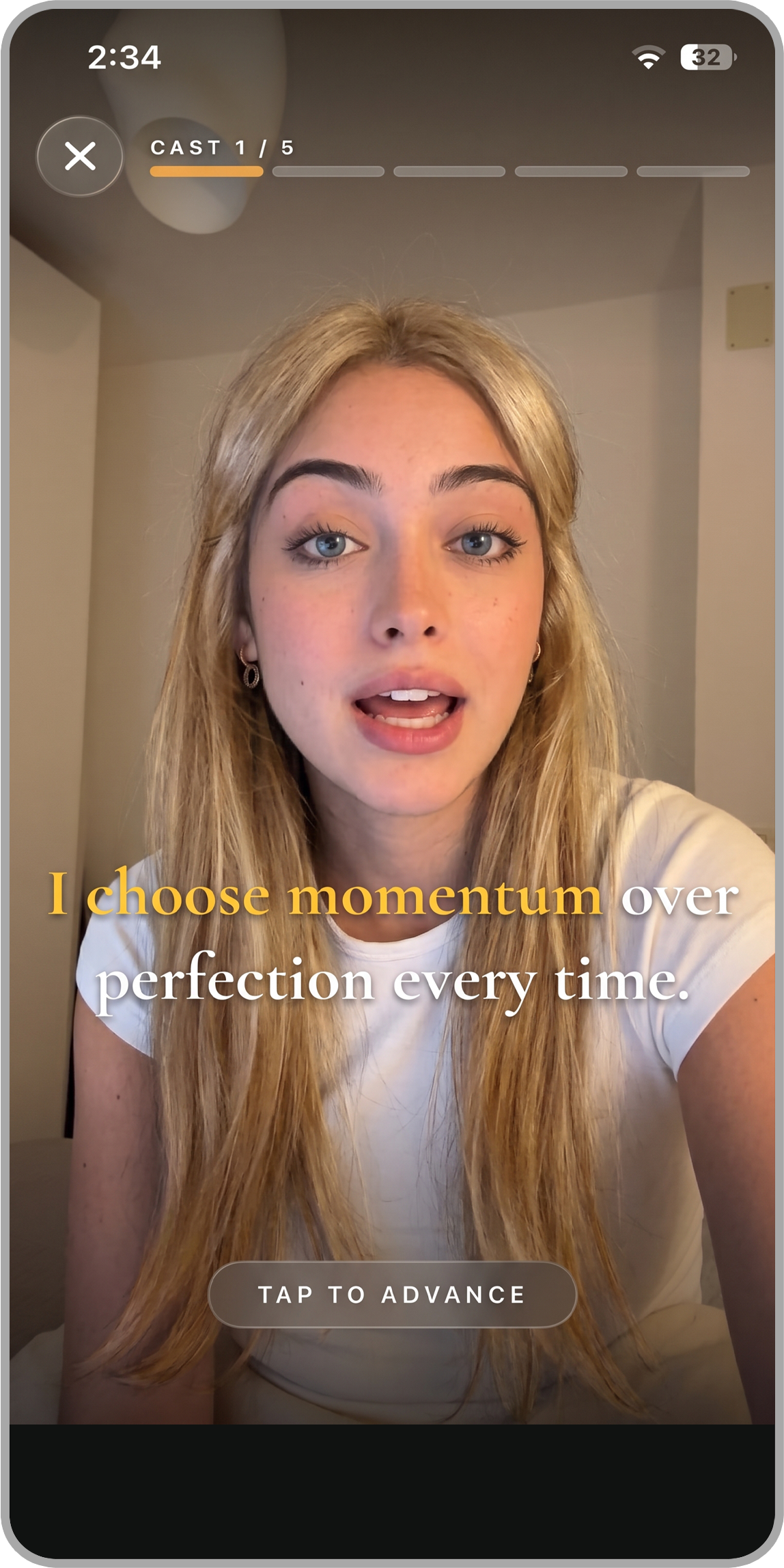
This is exactly why Breakout does not hand you a feed of generic lines to skim. It is the first affirmations app that listens. You choose specific, identity-based rewrites, then you cast them, meaning you speak each one out loud, and on-device speech recognition verifies you actually said it. There is no passive chanting on a timer. There is no rejected slogan repeated by rote. You say it, you hear it, you repeat it, and the app confirms you did.
That structure directly targets the two conditions that caused the backfire effect in the first place: generic statements and passive delivery. A specific, believable spell said with attention is simply a different act than a generic line chanted at a doorbell cue. Consistency is the magic, but only once the statement and the method are right.
Affirmations are not a trick that works on everyone the same way, and they are not magic. But the backfire effect is not a reason to avoid them. It is a map of exactly what to fix: make it specific, make it believable, and say it out loud.
Keep reading
- Do affirmations actually work?. The honest science, with conditions.
- Why don't my affirmations work?. The four fixable mistakes.
- Are affirmations pseudoscience?. Where the evidence holds up, and where the hype outruns it.
- The practice. The 10-minute daily ritual.
Sources
- Wood, J. V., Perunovic, W. Q. E., & Lee, J. W. (2009). Positive self-statements: Power for some, peril for others. Psychological Science, 20(7), 860-866.
- Sherman, D. K., & Cohen, G. L. (2006). The psychology of self-defense: Self-affirmation theory. Advances in Experimental Social Psychology, 38, 183-242.
Frequently asked
Can affirmations really make you feel worse?
For some people, yes, under specific conditions. Wood, Perunovic, and Lee (2009) found that people with low self-esteem who repeated 'I am a lovable person' felt worse afterward than people who did not repeat anything. The statement felt false, so it backfired instead of helping.
Who is most at risk of affirmations backfiring?
People with low self-esteem who repeat a statement they do not believe, especially when it is generic and said passively or silently. High self-esteem participants in the same study felt slightly better, not worse.
How do you avoid affirmations backfiring?
Start with a statement you can mostly accept today instead of one you flatly reject, keep it specific rather than generic, and say it out loud with attention instead of repeating it by rote. Belief and specificity are the two levers that matter most.
Does saying affirmations out loud reduce the backfire risk?
It helps, because rote silent repetition is closer to what backfired in the original study. Speaking a specific, believable line out loud is an active, deliberate act, not a passive chant. Breakout is built around that distinction: you say each spell aloud, and the app verifies you said it.
Should people with low self-esteem avoid affirmations altogether?
No. The research says the fix is the method, not avoidance. Ladder up from something believable, keep it specific, and speak it with intent. The backfire risk comes from generic, rejected, passive statements, not from the practice itself.