Identity & the brain
Can affirmations change your identity?
Yes, but not by announcing who you wish you were. Identity is built from evidence, and the loudest evidence you produce all day is what you say about yourself. Affirmations work on identity when they are specific, believable, and spoken out loud, because a spoken line is an action you took, not a thought you had. Reading one is not evidence of anything.
Nobody decides to become a runner. They run, often enough, until the word stops feeling borrowed. That is the whole mechanism, and it explains why most affirmations miss. They aim at the outcome and skip the person.
Can affirmations change your identity?
Yes, with conditions. But not the way the word "affirmation" usually gets used. You do not change your identity by declaring a destination. You change it by accumulating evidence that a certain kind of person exists in your body, and by describing that person out loud until the description stops sounding like a stretch.
Identity is not a decision. It is a running tally. Every action votes, and so does every sentence you say about yourself. The reason affirmations belong in this conversation at all is that speech is the one vote you can cast on demand, on a Tuesday, before you have any of the evidence yet.
The grammar of identity: noun beats verb
Here is the finding that makes this concrete, and it is stranger than it should be.
Researchers Christopher Bryan, Gregory Walton, Todd Rogers and Carol Dweck ran a study on voter turnout before the 2008 California general election (Bryan et al., 2011). Two surveys, nearly identical. One asked people about voting. The other asked them about being a voter. A verb versus a noun. That was the entire manipulation.
They then checked official state turnout records. In the noun group, 95.5 percent voted. In the verb group, 81.8 percent did. A gap of almost fourteen points, from one part of speech. They replicated it in the 2009 New Jersey election and got the same shape: 89.9 percent against 79.0 percent.
Nothing about the argument changed. Only whether the act was framed as something you do or someone you are. People reach for the identity when it is offered to them, and then they behave like it.
Your affirmations are making this choice every day, usually badly. "I want to be more confident" is a verb wearing a costume. "I am someone who speaks first in the room" is a noun.
"I don't" versus "I can't"
The same effect shows up in refusal, which is where most goals actually die.
Vanessa Patrick and Henrik Hagtvedt gave thirty women a health goal and split them into groups (Patrick & Hagtvedt, 2012). One group was told to refuse temptation with "I can't miss my workout." Another used "I don't miss workouts." Same refusal. Different owner.
After ten days, eight of the ten women using "I don't" had stuck with the goal. In the "I can't" group, one had.
"I can't" is a rule someone handed you, and rules invite negotiation. "I don't" is a fact about you, and there is nothing to argue with. Notice that both are things you say. The study did not change anyone's willpower. It changed a phrase, and the phrase changed the person holding it.
Goal-based lines vs. identity-based lines
| Goal-based | Identity-based | |
|---|---|---|
| The line | "I want to run a marathon" | "I am a runner" |
| Grammar | A verb, something you do | A noun, someone you are |
| What it targets | An outcome, out in the future | The person, available now |
| When you miss a day | Proof you are failing | One day off, by someone who runs |
| Where motivation comes from | Wanting the result | Acting in character |
| Ends when | You hit the number | It doesn't |
| What it needs from you | Discipline | Evidence |
Read the last row twice. A goal asks you to push. An identity asks you to prove something, and proof is easier to produce than force. That is why identity-based lines survive bad weeks. The goal-based version needs you to want it today. The identity-based version only needs you to act like yourself.
Why the vote has to be spoken
This is where the practice separates from the poster.
A line you read is reception. A line you speak is production. In a well-replicated finding known as the production effect, MacLeod and colleagues (2010) showed that words spoken aloud are remembered substantially better than the same words read silently, commonly 10 to 25 percent better. Producing a word makes it distinctive, and distinctive is what your memory keeps.
But there is a plainer reason, and it has nothing to do with memory. A spoken line is a thing that happened. It has a timestamp. Your ears were there. When you say "I am someone who follows through," out loud, in your own voice, you have just produced a small piece of evidence that the person exists, because the person just did something. A line you skim produces nothing. It is a thought you had, and you have thousands of those a day about which you are not held to account.
Look at where your current identity actually lives. It is not in a journal. You say it. Out loud, to other people, casually, without noticing: "I'm not really a morning person." "I'm terrible at this." That is a spoken identity, cast daily for years, and you are trying to unseat it with silent reading.
Your words are spells. That is why they call it spelling. The old ones got cast out loud by accident. The new one has to be cast the same way, on purpose.
The Breakout wedge: a vote that gets counted
Every other affirmations app hands you a beautiful line and hopes. Nothing about that is checkable. There is no difference the app can see between a day you meant it and a day you scrolled past it.
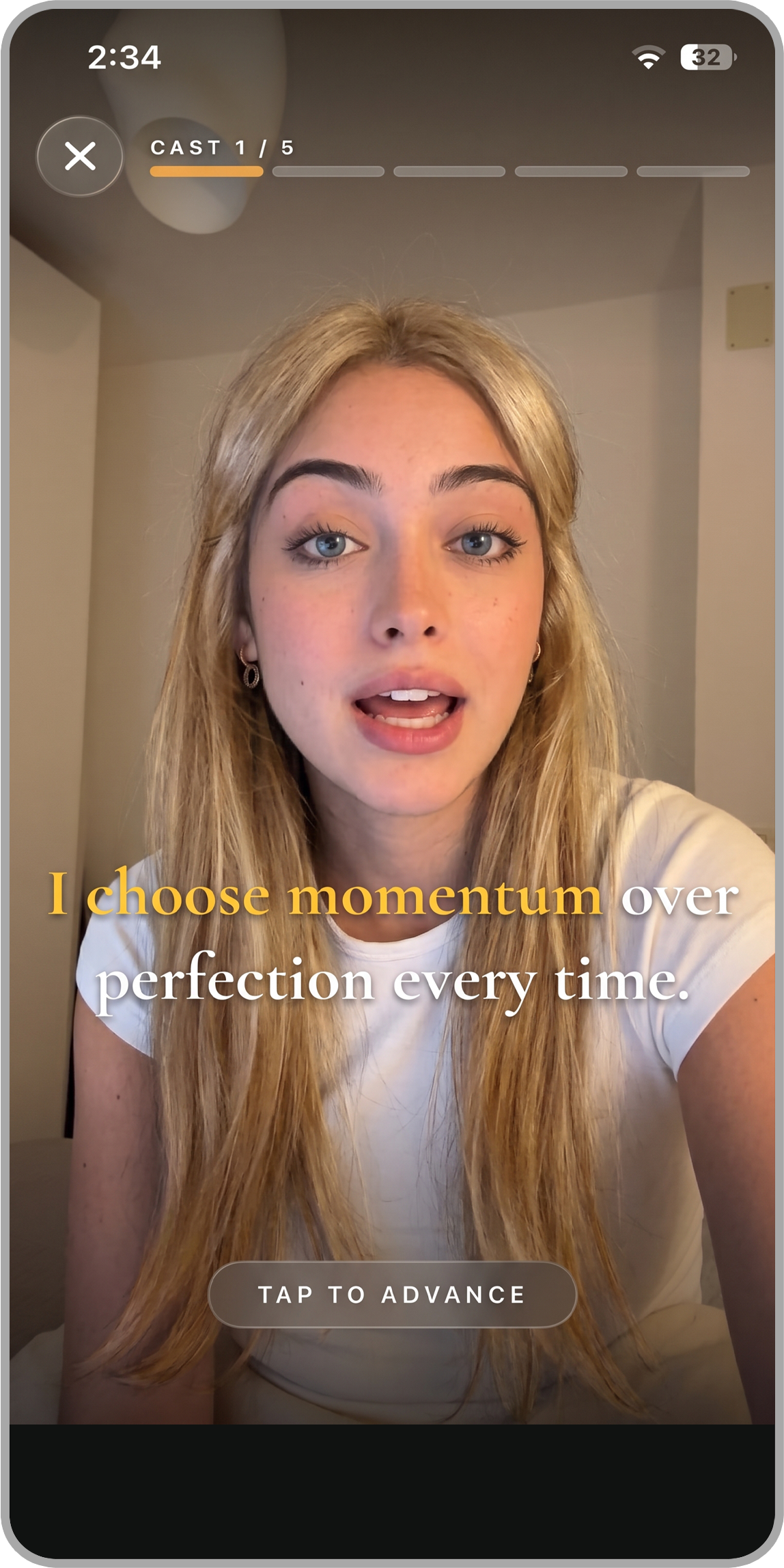
Breakout is the affirmations app that listens. You say your affirmations out loud and on-device speech recognition verifies every word, so a rep is a rep and not an intention. In Rewire, you choose the rewrite that names the person you are building, then you cast it daily until it is the line that answers first. The frequency-tuned audio sets the state you speak into.
Ten minutes a day. Speak it. Hear it. Repeat it. See how it fits together in the daily practice.
What this does not do
It does not install a new self by Friday. Lally and colleagues (2010) tracked habit formation and found automaticity took a median of 66 days, with a range from 18 to 254. Identity is slower than a habit, because it is made of habits.
It also will not survive contradiction forever. Say "I am someone who trains" while never training and the line goes hollow, fast. Speech is the opening vote, not the whole election. What makes it worth casting is that it is available today, costs ten minutes, and tends to pull the behavior along behind it.
The bottom line
Affirmations change identity when they stop describing a destination and start naming a person. Make the line a noun, not a wish. Make it specific enough to act on. Make it believable enough that you do not flinch. Then say it out loud, every day, until the evidence catches up with the claim.
You are already casting spells about who you are. Most of them just are not the ones you would choose.
Keep reading
- Can affirmations change your limiting beliefs?. Why repetition, not proof, built the line in your head.
- Can affirmations rewire your brain?. The neuroplasticity claim, handled honestly.
- How to write affirmations that work. The formula, with examples.
- How to make affirmations a daily habit. The ten-minute ritual that sticks.
Sources
- Bryan, C. J., Walton, G. M., Rogers, T., & Dweck, C. S. (2011). Motivating voter turnout by invoking the self. Proceedings of the National Academy of Sciences.
- Patrick, V. M., & Hagtvedt, H. (2012). "I don't" versus "I can't": When empowered refusal motivates goal-directed behavior. Journal of Consumer Research.
- MacLeod, C. M., Gopie, N., Hourihan, K. L., Neary, K. R., & Ozubko, J. D. (2010). The production effect: Delineation of a phenomenon. Journal of Experimental Psychology: Learning, Memory, and Cognition.
- Lally, P., van Jaarsveld, C. H. M., Potts, H. W. W., & Wardle, J. (2010). How are habits formed: Modelling habit formation in the real world. European Journal of Social Psychology.
Frequently asked
What is an identity-based affirmation?
It is a line about who you are rather than what you want. 'I want to stop avoiding hard conversations' is a goal. 'I am someone who says the difficult thing early' is an identity. The second one is a noun, not a wish, and research on identity framing suggests the grammar matters more than it looks.
Should affirmations say 'I am' or 'I am becoming'?
Use whichever one you can say without flinching today. 'I am' is stronger when you can accept it. 'I am becoming' is better than a line you reject outright, because an unbelieved statement tends to surface the counterargument instead of the belief. Start where you actually are, then climb.
Can you change your identity just by talking to yourself?
Not by talking alone. But talking is not nothing either, and it is the part you control every day. Speaking a specific line about who you are is a small, repeatable act of evidence. Behavior that matches it turns the claim into a fact. The words go first because they are the cheapest thing to change.
How long does it take to feel like a different person?
Longer than you want. Habit research puts automaticity at a median of 66 days, with a range from 18 to 254. The marker is not the day you feel transformed. It is the day you do the thing without negotiating with yourself first.
Is this the same as manifesting?
No. Manifesting says the words summon the outcome. This says the words shape who shows up, and the person who shows up does the work. Breakout is a personal development practice, not therapy or a medical product, and not a shortcut around effort.