Spoken vs. silent
Do you have to believe an affirmation for it to work?
No, you do not have to fully believe an affirmation for it to work, but belief matters more than almost anything else. Affirmations you find believable get encoded and acted on. Ones you flatly reject can backfire. The fix is not to force belief. It is to speak affirmations your mind will accept, then ladder up as they become true.
If affirmations have ever felt like lying to yourself, you already understand the most important rule about them. Belief is not a nice-to-have. It is the mechanism. And the good news is you do not need total belief. You need a line your mind will accept.
Do you have to believe an affirmation for it to work?
No, not fully. But you do have to find it believable enough that your mind does not reject it outright. Affirmations work by shifting how you see yourself, and you cannot shift toward a claim you completely disbelieve. When the gap between the words and your current self-image is too wide, the affirmation does not just fail. It can push you the other way.
This is the single most misunderstood thing about the practice. People repeat a grand line like "I am wealthy" or "I love my body," feel a quiet inner voice say "no you are not," and conclude affirmations do not work. What actually happened is they picked a spell they could not yet cast.
What the research says about belief
The clearest evidence comes from Wood, Perunovic and Lee (2009), published in Psychological Science. Researchers had 68 participants repeat the affirmation "I am a lovable person" and measured their mood and feelings afterward. The result surprised a lot of people. Participants with high self-esteem felt slightly better. But participants with low self-esteem, the people the affirmation was supposed to help most, felt worse than a control group who did no affirmation at all.
The reason was believability. For someone who already doubts they are lovable, the statement "I am a lovable person" highlights the gap between the claim and the belief. The mind counter-argues, lists the evidence against it, and you end up more focused on the doubt than the affirmation.
That is not a reason to abandon affirmations. It is a reason to pick believable ones. When the words land inside the range of what you can accept, they stop triggering the counter-argument and start doing their work.
The believability ladder
The fix is not to force belief you do not have. It is to lower the rung until you reach one you can stand on, then climb. Take the affirmation you wish were true, and build a bridge version that is believable right now.
| The stretch (rejected) | The bridge (believable) |
|---|---|
| I am rich | I am learning to manage my money with care |
| I love my body | I am grateful for what my body does for me |
| I am confident | I speak up when it matters, even when I am nervous |
| I am not anxious | I can feel calm return after a few slow breaths |
| Everyone likes me | I am someone worth getting to know |
The bridge line is not settling. It is the version your mind will accept without arguing, which means it is the version that can actually change something. As it becomes obviously true, you climb to the next rung. Belief is built, not declared.
Two more levers make any affirmation easier to believe. Make it specific rather than grand ("I speak with calm and clarity in meetings" beats "I am confident"), and frame the effort or direction rather than a finished result ("I am learning" and "I am becoming" are hard to dispute).
Why speaking makes belief easier
Here is where how you practice changes everything. Reading an affirmation in your head is easy to disbelieve, because it is easy to skim. Your eyes slide over "I am calm and capable" in half a second and your attention never fully arrives.
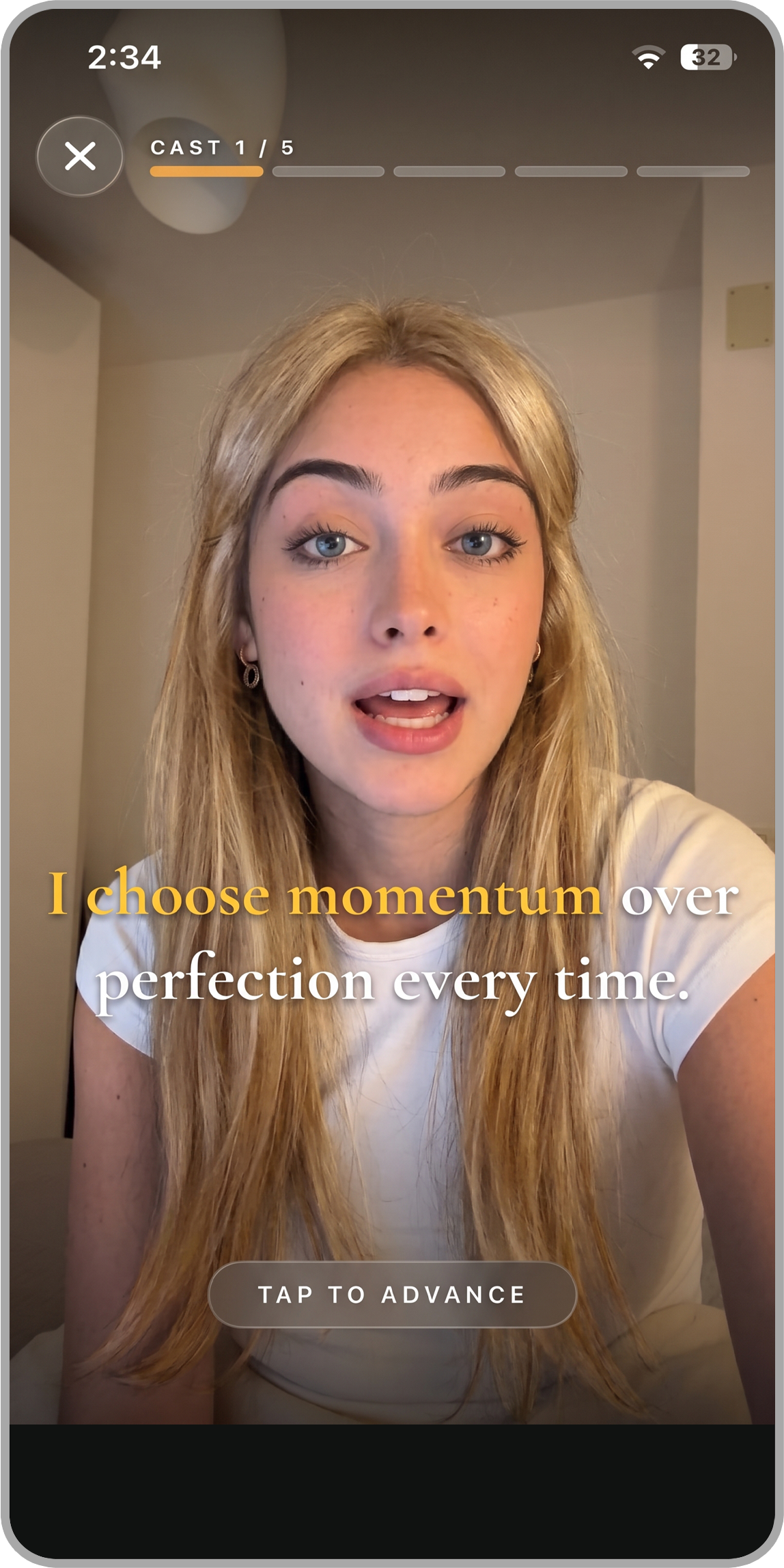
Saying it out loud is different. Hearing your own voice make a claim about yourself is a small act of commitment that silent reading cannot match. You cannot autopilot through a sentence you have to physically produce. That is why every other app hands you words to read, and reading never changed anyone. Your words are spells. That is why they call it spelling. And a spell only counts when you cast it out loud.
This is the whole idea behind Breakout, the first affirmations app that listens. You speak each affirmation aloud and on-device speech recognition verifies every word, so you cannot slip past the believable-but-effortful ones. You either said it or you did not. Then frequency-tuned audio helps the new thought settle. Belief is not summoned in one session. It is laid down, one spoken rep at a time.
The bottom line
You do not have to believe an affirmation completely for it to work, but you do have to keep it inside the range your mind will accept. Pick believable, specific lines. Speak them out loud, daily, until they are obviously true. Then ladder up. Consistency is the magic.
Related reading
- Can affirmations backfire and make you feel worse?
- Should you say affirmations out loud or in your head?
- How to write affirmations that actually work
Sources
- Wood, J. V., Perunovic, W. Q. E., & Lee, J. W. (2009). Positive self-statements: Power for some, peril for others. Psychological Science.
- Sherman, D. K., & Cohen, G. L. (2006). The psychology of self-defense: Self-affirmation theory. Advances in Experimental Social Psychology.
- MacLeod, C. M., Gopie, N., Hourihan, K. L., Neary, K. R., & Ozubko, J. D. (2010). The production effect: Delineation of a phenomenon. Journal of Experimental Psychology: Learning, Memory, and Cognition.
Frequently asked
Do you have to believe affirmations for them to work?
Not completely, but belief is the deciding factor. An affirmation you find plausible gets accepted and acted on. One you flatly reject can make you feel worse, especially if your self-esteem is already low. Aim for lines you can say without your mind arguing back.
What if I do not believe my affirmation at all?
Then it is too big a jump. Ladder down to a version you can accept. Instead of I am confident, try I am learning to speak up, even when I am nervous. Believable and slightly true beats grand and hollow every time.
Does saying an affirmation out loud make it easier to believe?
Yes. Hearing your own voice make the claim adds weight that silent reading does not. You cannot skim past it. Speaking it, and hearing yourself say it, is a small act of commitment that makes belief easier to build.
How do I make an unbelievable affirmation believable?
Make it specific, present the effort not the finished result, and start from something already true. Believable, specific, and spoken daily is the combination that changes the voice in your head.