Habit & ritual
Does the 369 method work for affirmations?
The 369 method works only as well as its parts do. Writing a present-tense affirmation three times in the morning, six in the afternoon, and nine at night borrows focus, repetition, and daily consistency, and those three things are real. The digits, lifted from Tesla numerology, do nothing on their own. And writing silently is the weak version. Say the lines out loud and the same reps land harder.
Does the 369 method work for affirmations?
To the degree its parts do, and no further.
Strip the 369 method down and you find three ordinary ingredients: you write a goal down, you repeat it, and you do it every day. Each of those has research behind it. What has nothing behind it is the part the method is named for. The numbers 3, 6, and 9 are decoration. Write your line four times or seven times and the result is identical, because the digits were never the mechanism. Your attention was.
So yes, people get results. They get them for reasons the branding gets wrong.
Where the 369 method comes from
The method is newer than it sounds. It spread through TikTok in 2020 and 2021, credited to a creator named Karin Yee, who stitched together two older sources: Nikola Tesla's private obsession with the numbers 3, 6, and 9, and the law-of-attraction teachings of Neville Goddard and Abraham Hicks.
Tesla did fixate on those numbers. He reportedly circled buildings three times and favored hotel rooms divisible by three. He is often quoted saying that if you understood the magnificence of 3, 6, and 9, you would hold a key to the universe. What he never did was describe writing affirmations in that pattern. The manifestation routine was assembled decades later and attached to his name for the mystique.
The practice itself is simple. Pick one goal. Turn it into a present-tense affirmation. Write it by hand three times when you wake, six times in the afternoon, and nine times before bed. Repeat daily, usually for 21 days.
What is actually doing the work
Two of those steps are doing the heavy lifting, and neither is the number.
The first is writing a goal down at all. Gail Matthews, a psychologist at Dominican University, ran a study with 267 participants split into five groups by how firmly they committed to their goals. The group that only thought about their goals landed near the bottom. The groups that wrote them down did markedly better, and the ones who wrote them and reported progress to a friend did best of all, with more than 70 percent reaching or passing the halfway mark, against 35 percent for the think-only group. Committing a goal to a physical page focuses attention in a way that thinking about it does not.
The second is repetition with consistency. Doing the same short practice at set points across the day is sound habit design. But here the method quietly reveals its own ceiling, because it has you repeat the words silently, on paper, and silent repetition is the slow lane.
That is the gap Breakout is built on.
What the 369 method is actually made of
| Ingredient | Does it help? | Why |
|---|---|---|
| The digits 3, 6, 9 | No | Borrowed from Tesla numerology. There is no mechanism in the numbers themselves. |
| Writing it down | Yes | Committing a goal to paper focuses attention. Matthews found writers hit their goals far more often. |
| Present-tense, specific wording | Yes | A believable, identity-based line beats a vague wish you do not buy. |
| Repetition, 18 times a day | Partly | Familiarity builds with repetition, but silent reps are the weakest form of it. |
| Morning, afternoon, night spacing | Yes | Spacing a small practice across the day is real habit design. |
| Saying it silently in your head | Weakest | No motor act, no self-voice feedback, and nothing that can be verified. |
| Saying it out loud | Strongest | The production effect. 10 to 25 percent better recall, and you can prove you did it. |
The bottom two rows are the whole argument. The 369 method spends its energy on the numbers and leaves the single highest-leverage variable, whether you speak, sitting on the table.
The number 3-6-9 is the least important part
It is worth saying plainly, because the branding leans so hard on it: the digits carry no power. There is no study, no mechanism, no reason that writing something nine times at night beats writing it eight or ten. Tesla was a genius of alternating current, not of affirmations. The numerology is a story wrapped around a few real habits to make them feel special.
Which is fine, if the story gets you to show up. Ritual helps people stay consistent, and consistency is the magic. But do not confuse the wrapper for the mechanism. If you dropped the counting entirely and simply said your line, with attention, three times a day, you would keep everything that works and lose nothing that does.
The catch: writing silently is the weak version
Here is the honest problem with 369 as usually taught. Eighteen handwritten reps a day is a lot of effort routed through the quietest channel you have.
When you write a line silently, one system engages. When you say the same line out loud, three do. You form the words as a motor act. You hear them arrive as sound. And the sound is your own voice, which your brain treats differently than any other voice on earth. Colin MacLeod and colleagues (2010) named this the production effect: words said aloud are remembered 10 to 25 percent better than words read or written silently, because the act of saying them leaves a distinctive record your brain can find later. Forrin and MacLeod (2018) then showed the gradient. Speaking beat hearing your own recorded voice, which beat hearing someone else, which beat silence.
Silent writing sits at the bottom of that gradient. So the 369 method asks for heavy reps and pays out at the lowest rate. Speak the line instead, even once with your full voice, and you outwork a page of silent copies.
Your words are powerful. That is why they call it spelling. A line you write and never say is a spell you drew but never cast.
The part where the app listens
There is one more thing silent writing cannot do. It cannot be verified.
You can write your affirmation nine times or nine hundred, and nobody knows whether the words meant anything or your hand was on autopilot while your mind was elsewhere. The page looks identical either way. Every affirmations app has the same blind spot: it records that you opened it, because opening it is the only thing it can detect.
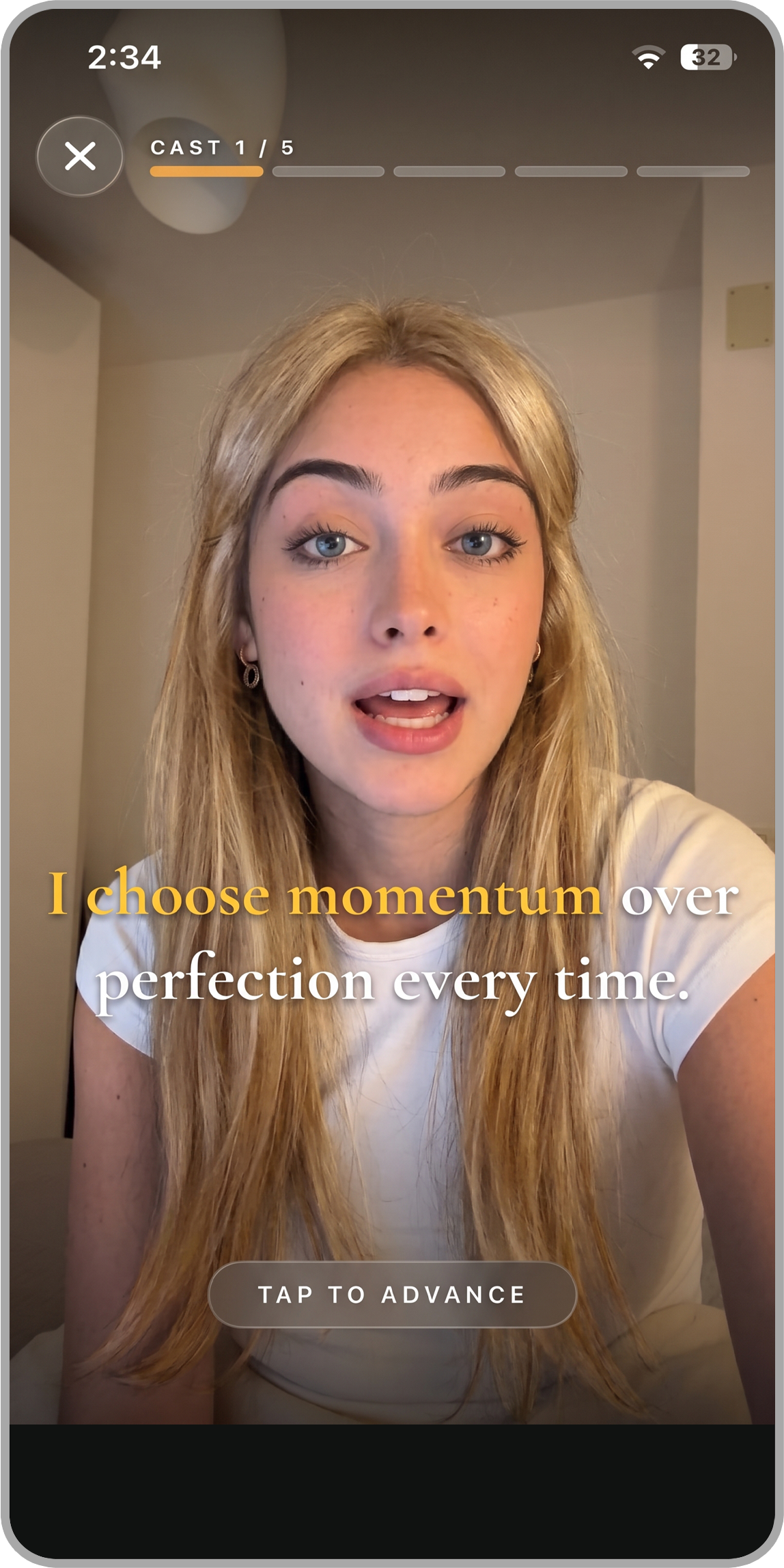
Breakout is the first affirmations app that listens. On-device speech recognition verifies every word as you cast it. Not "did you open the app." Did you say it out loud. Nothing counts until you speak, so the streak on your screen is a record of something that actually happened, not a page you can fill while thinking about lunch.
That is the whole product, and it is the missing half of the 369 method. Keep the daily ritual. Keep the specific, present-tense line. Drop the numerology, and cast the words out loud where they carry.
Speak to yourself differently, and your life will follow. It takes about ten minutes a day, and it is free to start.
How to run a spoken 369, if you like the structure
If the rhythm of the method keeps you consistent, keep it. Just move it into your voice.
Pick one line, present tense and specific. Not "I am successful." Something you can almost believe, like "I speak with calm and clarity in every meeting."
Say it out loud, morning, afternoon, and night. Drop the exact counts. Three attentive spoken reps beat eighteen silent ones. If you want to keep writing, say each line aloud as your hand moves.
Give it real time. Ignore the 21-day promise. Lally and colleagues (2010) put habit automaticity at a median of 66 days. Show up daily and let consistency do the work.
Where to go next
- The pillar: the 369 method, the full walkthrough and the spoken version.
- Affirmations vs. journaling for where writing earns its place, and where it does not.
- Why do affirmations work better out loud? for the production effect in full.
- How to make affirmations a daily habit for the consistency piece.
- Do you have to believe an affirmation for it to work? for the condition that decides everything.
Sources
- Matthews, G. (2015). The impact of commitment, accountability, and written goals on goal achievement. Dominican University of California.
- MacLeod, C. M., Gopie, N., Hourihan, K. L., Neary, K. R., & Ozubko, J. D. (2010). The production effect: Delineation of a phenomenon. Journal of Experimental Psychology: Learning, Memory, and Cognition.
- Forrin, N. D., & MacLeod, C. M. (2018). This time it's personal: The memory benefit of hearing oneself. Memory, 26(4), 574-579.
- Lally, P., van Jaarsveld, C. H. M., Potts, H. W. W., & Wardle, J. (2010). How are habits formed: Modelling habit formation in the real world. European Journal of Social Psychology, 40(6), 998-1009.
Breakout is a personal development practice, not therapy and not medical care.
Frequently asked
What is the 369 method?
A manifestation routine popularized on TikTok. You turn one goal into a present-tense affirmation and write it by hand three times in the morning, six in the afternoon, and nine at night, usually for at least 21 days. It borrows the numbers from Nikola Tesla's fascination with 3, 6, and 9.
Does the 369 method actually work?
It works to the degree its ingredients do. Written focus, repetition, and daily consistency all have research behind them. The specific digits 3, 6, and 9 do not. Nothing measurable changes if you write four times or seven. The mechanism is your attention, not the numerology.
How long does the 369 method take to work?
The common claim is 21 days, but that number is a myth with no basis in habit research. Lally and colleagues (2010) found habits reached automaticity at a median of 66 days, with a range of 18 to 254. Consistency matters far more than the calendar.
Should you say the 369 method out loud or write it?
Writing is the tradition, but silent writing skips the strongest ingredient. Speaking adds the production effect, a 10 to 25 percent memory advantage, plus your own voice as feedback. Say each line out loud as you write it, or speak instead of writing.
Is the 369 method based on real science?
The numerology is not. Tesla never described a manifestation routine. The parts that hold up, written intention, repetition, and daily practice, are supported by ordinary psychology, not by anything special about 3, 6, or 9.