Comparisons
Free vs. paid affirmation apps: which is worth it?
Free vs. paid affirmation apps is the wrong question. Most of both hand you the same thing, written affirmations to read and forget, so price is not the variable that decides whether it works. The mechanic is. A free app that makes you speak aloud beats a paid one that hands you a quote. Pay for a practice, not a prettier feed. Start free, and judge it by whether it changes what you do.
Free vs. paid affirmation apps: which is worth it?
Neither, if both just show you words to read. That is the honest answer, and it saves you from a comparison that misses the point.
Walk through the app store and the free and paid tiers blur together. Both give you a library of affirmations. Both send a reminder at 8am. Both wrap it in a calming background. The paid one adds more categories, prettier screens, and a subscription. The mechanism underneath is identical, and the mechanism is the only thing that decides whether any of it works.
So the real question is not how much you pay. It is what the app makes you do. An app that makes you speak beats an app that makes you scroll, whether it costs zero or ten dollars a month.
What free and paid affirmation apps actually sell
Most of this category, at every price, sells exposure. The theory is that if you see the right sentence often enough, it sinks in. Free apps deliver exposure with ads or a smaller library. Paid apps deliver more exposure, without ads, with better art.
Exposure is not the mechanism. Production is. A sentence you read and a sentence you say out loud do not land the same way, and no amount of paying changes which one you did.
That is why the free-vs-paid frame is a trap. It compares two versions of the same passive product and asks which passive product is better. The version that works is a different product entirely.
The number that reframes the whole comparison
There is a well replicated memory effect called the production effect. MacLeod et al. (2010) had people read some words silently and speak others aloud, then tested recall. Words spoken aloud were remembered substantially better, with boosts in the range of 10 to 25 percent over silent reading. Saying the word, hearing yourself say it, and feeling it in your mouth makes it distinctive in a way that skimming never does.
Notice what that finding has nothing to do with. It has nothing to do with price, ad-free playback, or how many categories the library holds. The variable that moved memory was speaking, not spending.
So when you weigh a free app against a paid one, you are usually weighing two silent readers against each other. Both sit on the wrong side of that 10 to 25 percent. The upgrade that matters is not free to paid. It is silent to spoken.
Does paying make you stick with it?
Sometimes, for a while. Gourville and Soman studied how payment timing shapes consumption and found what they called payment depreciation. In one analysis of health-club members, attendance spiked right after each bill and drifted down as the payment faded from memory, then spiked again at the next charge. A visible cost can focus your commitment in the short run.
But two things are true about that. The bump fades, which is why gyms sell annual plans and count on you disappearing by March. And it never repairs a passive design. Paying more attention to an app that asks nothing of you still ends with you asking nothing of yourself. Commitment that comes from a rep you perform outlasts commitment that comes from a charge you regret.
Free vs. paid, side by side
| Free (passive) | Paid (passive) | The version that works | |
|---|---|---|---|
| What you do | Read a sentence, swipe | Read a nicer sentence, swipe | Speak a spell out loud, daily |
| What the app knows | That you opened it | That you opened it | That you actually said it |
| The affirmations | Generic, limited | Generic, unlimited | Specific enough to believe |
| The mechanism | Exposure | Exposure, plus ambience | Production, plus repetition |
| What the price buys | Nothing, with ads | More content, no ads | A practice, verified |
| After 30 days | A folder of screenshots | A prettier folder of screenshots | A voice in your head that sounds different |
Read that honestly against whatever you are using now. If it lives in either passive column, the price was never the problem. The design was.
The Breakout wedge, plainly
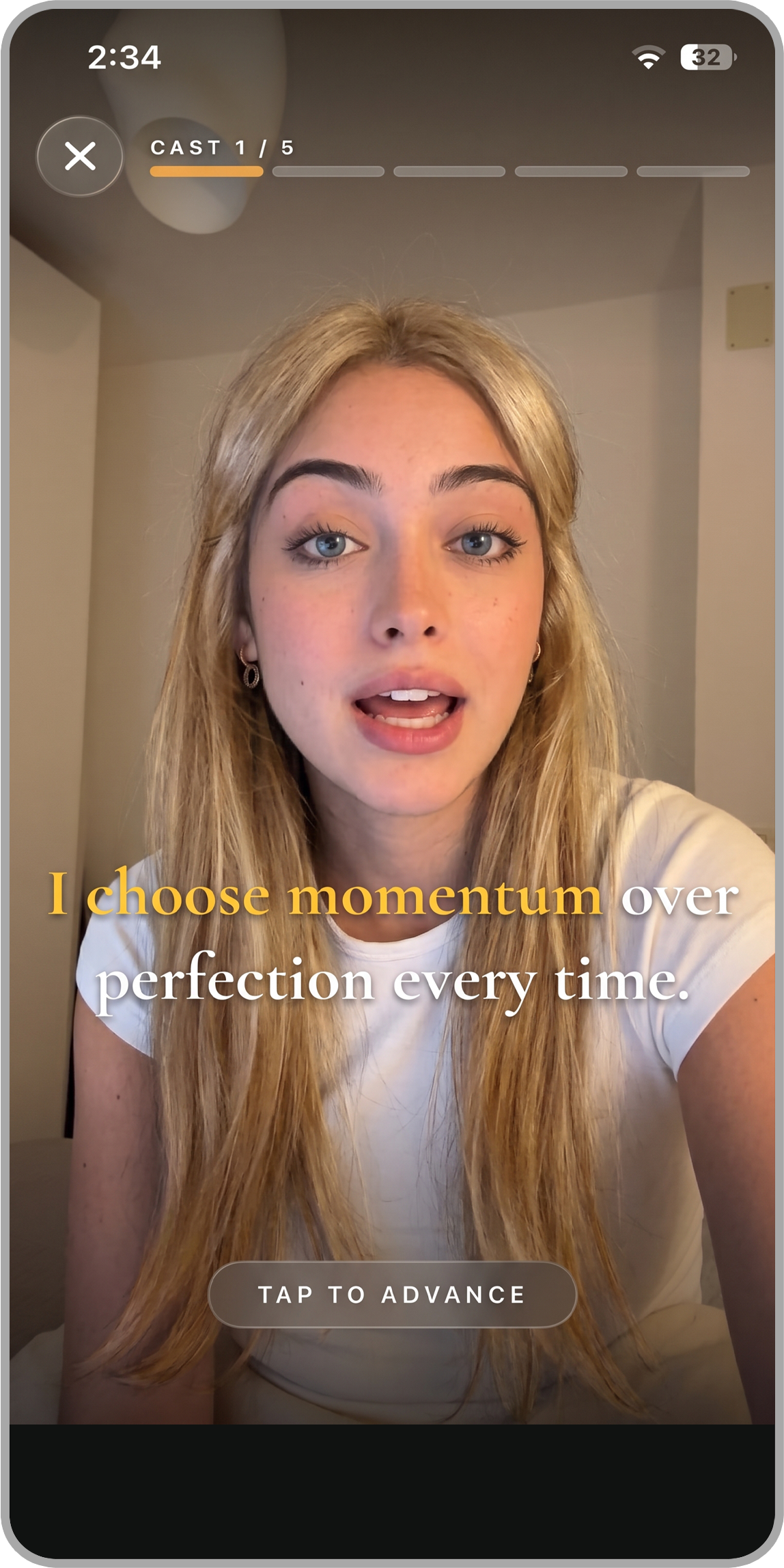
Breakout is the first affirmations app that listens. You do not read your spells. You cast them out loud, and on-device speech recognition checks every word before the rep counts. Speak it, hear it, repeat it. About ten minutes a day.
That one decision is why the free-vs-paid question stops mattering. The app is free to start, so you can feel the mechanic before you spend anything. And what you eventually pay for is not more sentences. It is a practice that knows whether you showed up, not whether you opened a screen.
We also stack your voice over frequency-tuned audio, which is where Positive Brainwashing comes in. You are not listening to affirmations. You are performing them, while your ears are somewhere useful. A free quote book cannot do that, and neither can a paid one.
How to choose in five minutes
- Ignore the price. Open the app and find out what it makes you do. If the answer is read, close it.
- Check whether it can tell if you spoke. Silent affirmations are unfalsifiable. Nobody, including you, can confirm you did them.
- Look at the lines. Are they specific enough for you to almost believe, or generic wallpaper? Stretch lines backfire.
- Try the free tier of the one that makes you speak. Do the rep out loud, once a day, for a week.
- Only then compare cost. Let money be the tiebreaker between apps that pass the first four tests, not the first thing you look at.
Most people run this backwards. They compare price, subscribe to the prettier feed, and quit by day nine. Choose the mechanic first and the bill sorts itself out.
The short answer
Free vs. paid affirmation apps is the wrong axis. A free app that makes you speak out loud beats a paid one that hands you a quote, every time. Pay for a practice, never for a nicer feed, and start with the free version so the app has to earn the upgrade.
Start with the practice, then read why affirmations work better out loud. For the head to head, we ranked the category in best affirmation apps 2026 and did the cost-benefit math in are affirmation apps worth it. The evidence sits in do affirmations actually work, and the mechanism on spoken affirmations and binaural audio.
Breakout is a personal development tool, not therapy and not medical care.
Sources
- MacLeod, Gopie, Hourihan, Neary & Ozubko (2010). The production effect: Delineation of a phenomenon. Journal of Experimental Psychology: Learning, Memory, and Cognition.
- Gourville & Soman (2002). Pricing and the Psychology of Consumption. Harvard Business Review.
- Forrin & MacLeod (2018). This time it's personal: the memory benefit of hearing oneself. Memory.
- Baumel, Muench, Edan & Kane (2019). Objective User Engagement With Mental Health Apps. Journal of Medical Internet Research.
Frequently asked
Are free affirmation apps good enough?
A free affirmation app is good enough if it makes you speak the words out loud and keeps you to a daily rep. Most free apps only show you text, which is the same passive product the paid ones sell. The mechanic matters more than the price tag.
What do you actually pay for in a paid affirmation app?
Usually more content, nicer visuals, and reminders. Rarely a better mechanism. If the paid tier still just shows you affirmations to read silently, you are paying for volume, not for anything that changes your behavior.
Does paying make you more likely to stick with it?
Sometimes. Research on payment and consumption suggests a visible cost can raise commitment for a while. But that fades, and it never fixes a passive design. A rep you have to perform holds better than a subscription you forgot you bought.
Is Breakout free?
Breakout is free to start. You can cast your spells, speak them aloud, and feel the mechanic before paying anything. The point is not free vs. paid. The point is that you speak the words and the app verifies you did.
How do I choose between a free and paid affirmation app?
Ignore the price first. Ask whether the app makes you say affirmations out loud, whether it can tell if you did, and whether the lines are specific enough to believe. Answer those, then let cost be the tiebreaker.