Spoken vs. silent
Do affirmations work if you just listen to them?
Only a little. Listening to affirmations builds familiarity with a phrase, and familiarity makes a statement feel truer over time. That is real, and it is not nothing. But it is the weakest version of the practice. Memory research puts a clear ladder in place: speaking a phrase aloud beats hearing yourself say it, which beats hearing someone else say it, which beats reading it in silence. Listening only puts you on the third rung.

- Affirmations
- Positive Brainwashing
Search "affirmations" and most of what comes back is audio. Hour-long tracks, sleep loops, subliminals under rain sounds. All of it built on one comfortable assumption: that you can absorb a new belief the way you absorb a podcast. Here is the honest answer.
Do affirmations work if you just listen to them?
A little. Not enough.
Listening does one real thing. Every time you hear a statement, it gets easier to process the next time, and your mind reads that ease as truth. Dechêne and colleagues (2010) pooled 51 studies on this effect and found a solid advantage for repeated statements over novel ones, d = 0.53, and it held whether the repetitions were minutes or weeks apart. So a phrase you have heard four hundred times does start to feel more familiar than one you have never heard. That is the entire mechanism behind listening, and it is genuinely part of how belief gets built.
But familiarity is the floor, not the ceiling. A phrase can feel completely familiar and still not feel like yours. You can recite an ad jingle from your childhood word for word without believing a syllable of it.
What the research says about hearing versus speaking
The clearest evidence comes from a study designed almost exactly for this question.
Forrin and MacLeod (2018) had participants study words under four conditions: reading them silently, hearing someone else read them, hearing a recording of their own voice reading them, and reading them aloud themselves. Memory came out in a clean gradient. Speaking aloud was strongest. Hearing your own voice landed in the middle, above hearing a stranger and below producing the words yourself. Silent reading came last.
Two separate things are doing work there. One is the self-referential tag, the fact that the voice is yours. The other is the physical act of production, the motor event of saying it. Listening gives you neither. Listening to your own recording gives you one of the two.
The wider production effect sits behind this. Across MacLeod and colleagues' work (2010), words spoken aloud are recalled roughly 10 to 25 percent better than the same words read silently. The gap is not subtle, and it comes from doing rather than receiving.
The listening ladder, honestly rated
| What you do | What it actually gives you | Strength |
|---|---|---|
| Read affirmations silently | Exposure. Nothing distinctive to remember it by. | Weakest |
| Listen to someone else's affirmation track | Familiarity, plus a calmer state. No self-reference, no production. | Weak |
| Listen to a recording of your own voice | Familiarity plus a self-referential tag. The phrase is at least yours. | Moderate |
| Say the affirmation out loud | Production plus self-reference plus hearing it. The full effect. | Strongest |
| Say it out loud over frequency-tuned audio | Everything above, with the state handled underneath it. | Strongest, layered |
Notice what moves you up the ladder. It is never the quality of the audio. It is how much of the work is yours.
The subliminal problem
The purest form of "just listen" is the subliminal track, where the affirmations are buried under music too quietly to consciously hear. This has been tested properly.
Greenwald, Spangenberg, Pratkanis and Eskenazi (1991) ran three double-blind replications on commercial subliminal self-help tapes, 237 participants, all of them people who actually wanted the promised results, all using the tapes exactly as the manufacturers instructed for a month. The researchers swapped the labels. Some people using the memory tape were told it was the self-esteem tape, and the reverse.
Neither tape produced its claimed effect. What did show up was more interesting: more than a third of participants reported improvement in whatever the label promised, regardless of what was actually on the tape. People got the result they were told to expect, from a tape that was not delivering it.
That is worth sitting with. It does not mean audio is worthless. It means expectation is powerful and passive absorption is not, and if you cannot tell the difference between the two, you can spend a year listening and call it practice.
So what is listening actually good for?
Three things, and they are worth having.
It sets the state. Frequency-tuned audio settles you before you speak. A nervous system that is not braced takes a new line more easily. That is the whole reason we build audio into the practice rather than around it.
It keeps the language close. Hearing well-written lines regularly gives you better raw material. Most people's affirmations fail because the wording is generic, and exposure to sharper phrasing fixes that faster than staring at a blank page.
It is easy to repeat. Consistency is the magic, and the easiest thing to do daily is the thing that requires nothing of you. Audio is the low bar you can always clear on a bad day.
None of those is the same as changing what you believe about yourself. They are conditions for it.
The version that actually works
Here is where we are different, and it is the entire reason Breakout exists.
Every other affirmations app hands you something to receive. A screen to read, a track to play. Nothing is asked of you, and nothing can be checked. A silent or passive session is unfalsifiable, which is exactly why it quietly becomes nothing. You can complete a hundred of them and have no evidence that a single line ever reached you.
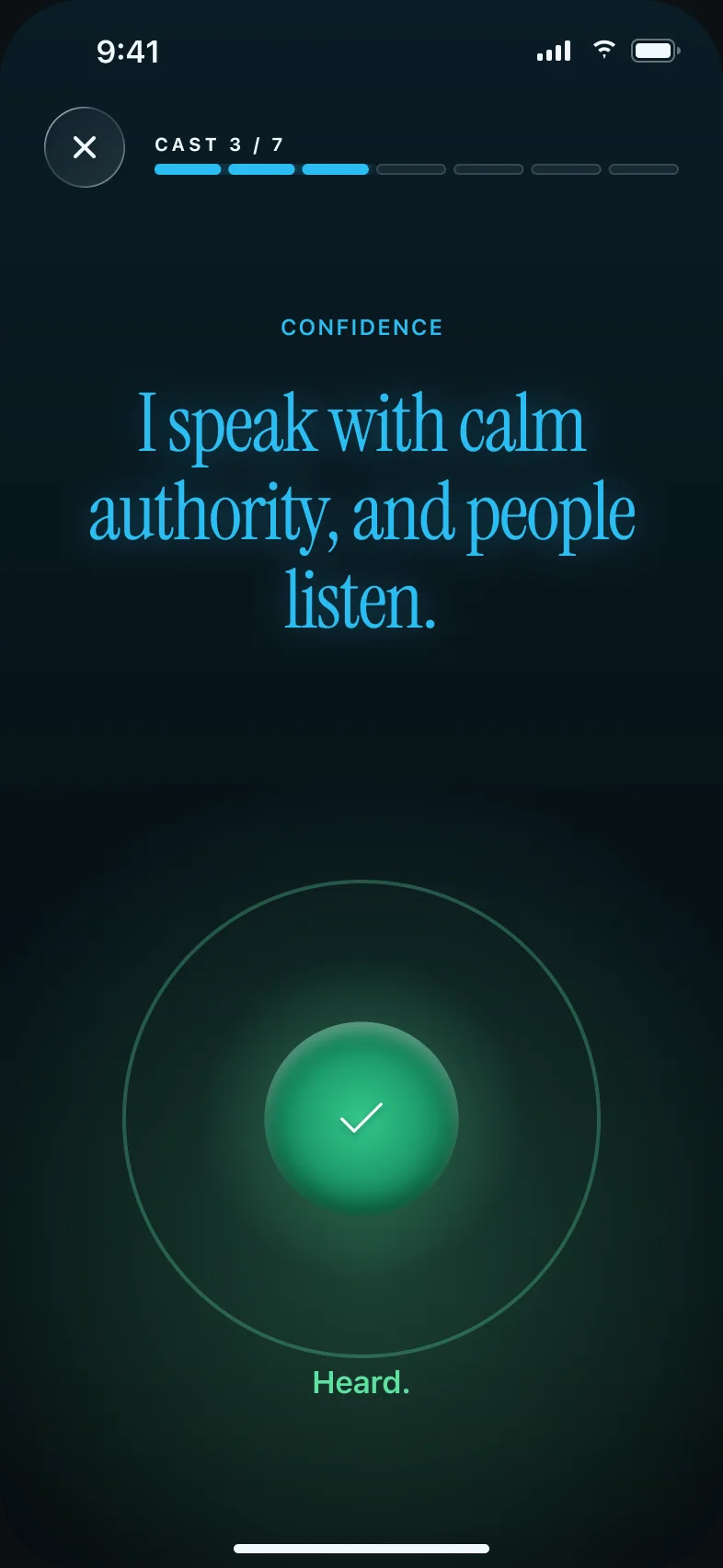
Breakout is the first affirmations app that listens. You say the spell out loud, and on-device speech recognition verifies every word. Not a checkbox. The actual sentence, out of your actual mouth, confirmed. A read affirmation is a thought you had. A spoken one is a thing that happened.
Then the listening layer goes where it belongs, underneath. That is Positive Brainwashing, spoken spells over frequency-tuned audio, running while your hands are busy. It is the supplement. The casting is the practice.
Your words are powerful. That is why they call it spelling. But a spell you never say out loud is just a sentence someone else wrote.
Cast it in Rewire, layer the audio in the practice, and let the track do the small job while your voice does the real one.
Related reading
- Should you say affirmations out loud or in your head?
- Why do affirmations work better out loud?
- Do affirmations work while you sleep?
- Can you combine affirmations with binaural beats?
Pillars: Spoken affirmations · Binaural audio
Sources
- Greenwald, A. G., Spangenberg, E. R., Pratkanis, A. R., & Eskenazi, J. (1991). Double-blind tests of subliminal self-help audiotapes. Psychological Science, 2(2), 119 to 122.
- Forrin, N. D., & MacLeod, C. M. (2018). This time it's personal: the memory benefit of hearing oneself. Memory, 26(4), 574 to 579.
- MacLeod, C. M., Gopie, N., Hourihan, K. L., Neary, K. R., & Ozubko, J. D. (2010). The production effect: delineation of a phenomenon. Journal of Experimental Psychology: Learning, Memory, and Cognition, 36(3), 671 to 685.
- Dechêne, A., Stahl, C., Hansen, J., & Wänke, M. (2010). The truth about the truth: a meta-analytic review of the truth effect. Personality and Social Psychology Review, 14(2), 238 to 257.
Breakout is a personal development practice, not therapy and not medical care. It does not diagnose, treat, or cure anything.
Frequently asked
Do affirmations work if you just listen to them?
Partially. Listening builds familiarity with a phrase, and repeated exposure makes statements feel more true. But listening is the weakest rung of the practice. In memory research the ordering is consistent: speaking aloud beats hearing your own recorded voice, which beats hearing someone else, which beats silent reading. Listening alone puts you third.
Are affirmation audio tracks on YouTube or Spotify useless?
No, but they are a supplement, not the practice. They set a state, they keep the language in front of you, and they are easy to repeat daily. What they cannot do is make the claim in your own voice. Use them as the layer underneath your practice, not instead of it.
Do subliminal affirmations work?
The evidence is poor. In a double-blind study of commercial subliminal self-help tapes with 237 participants, neither the memory tapes nor the self-esteem tapes produced their claimed effects. What people did report was improvement matching whatever the label said, regardless of what was actually on the tape.
Is listening to affirmations while doing something else effective?
It is better than skipping them, and it is not a substitute for a focused session. Divided attention means the phrase gets processed shallowly. Speak your lines out loud for a few minutes first, then let the audio run in the background afterwards if you want the exposure.
Does listening to a recording of my own voice work better?
Yes, slightly. Hearing your own voice sits above hearing someone else's, because the phrase carries a self-referential tag. It still sits below actually speaking the line, which adds the physical act of production on top. Both, in that order, is the strongest version.