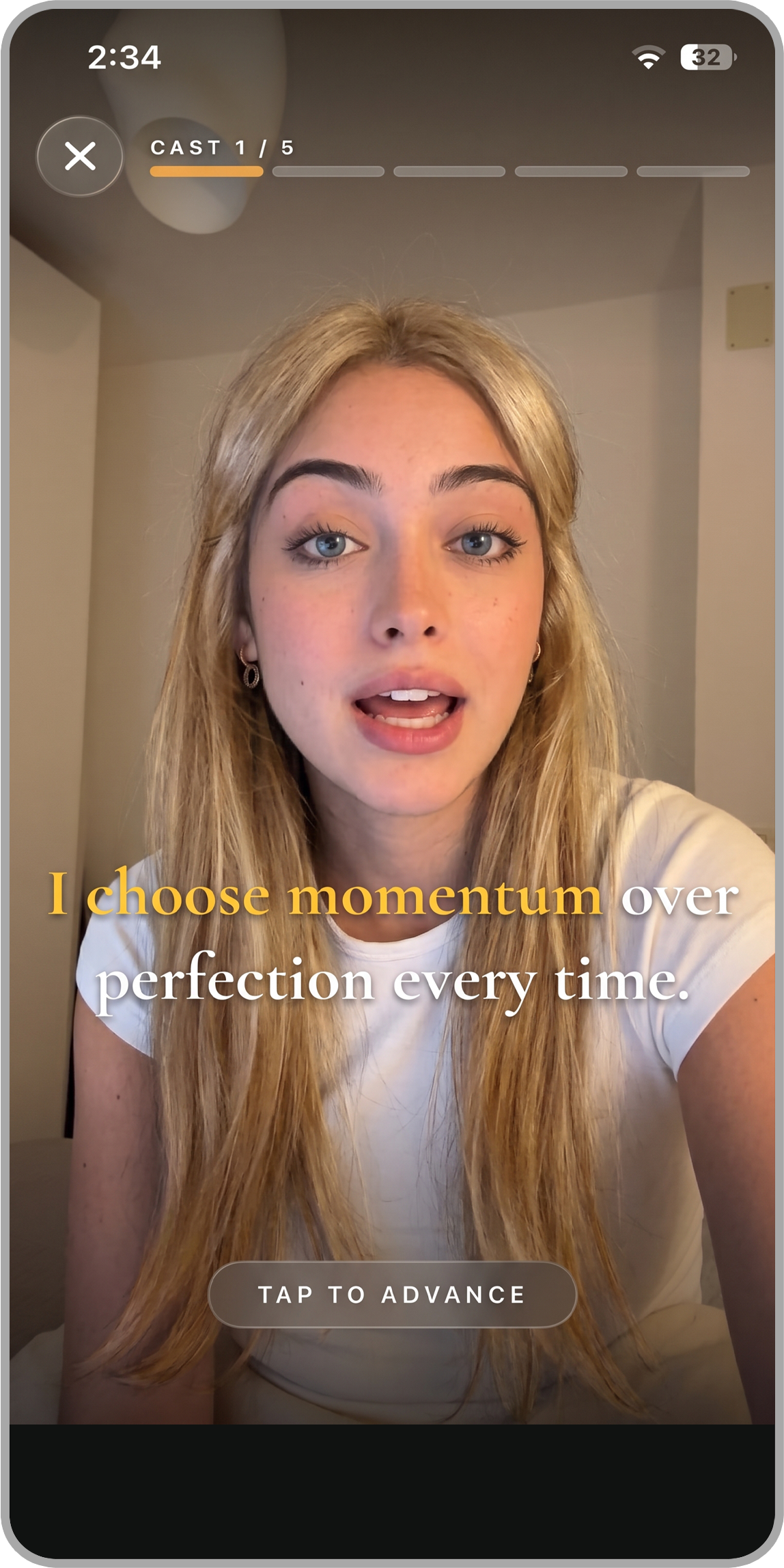
Spoken vs. silent
How do you say affirmations the right way?
Say affirmations the right way by speaking them out loud, in the present tense, in language you can actually believe, and doing it daily. Out loud beats silent, because speaking is a motor act your brain records. Specific and believable beats grand and hollow. And consistency is what turns a sentence into a pattern. Read them and nothing moves. Cast them and something does.
How do you say affirmations the right way?
You say affirmations the right way by speaking them out loud, in the present tense, in words you can actually believe, every day.
That is the whole method in one sentence. Most people get it wrong in the same three ways: they read silently, they reach for lines too grand to believe, and they quit before the pattern sets. Fix those three and you have a practice that works.
Here is the step by step.
Say them out loud
Start here, because this is the step everyone skips.
When you read a line silently, one system fires. When you say it out loud, three fire. You form the words as a motor act. You hear them arrive as sound. And the sound is your own voice, which your brain treats differently than any other voice on earth.
Memory researchers call this the production effect. In 2010, Colin MacLeod and colleagues at the University of Waterloo had people study word lists, some read silently, some read aloud. The spoken words were remembered far better, a boost that has landed between 10 and 25 percent across the studies that followed. The reason is distinctiveness. A word you said out loud leaves an extra record, the memory of the act of saying it. A silently read word leaves nothing behind but itself.
This is the Breakout wedge in one finding. Reading never did much. Speaking does. For more, see why affirmations work better out loud.
Make them specific and believable
The second mistake is aiming too high.
There is a real risk in grand affirmations. Wood, Perunovic and Lee (2009) had people repeat "I am a lovable person," and the ones who needed it most, people with low self-esteem, felt worse afterward, not better. The line was too far from what they believed, so their own mind pushed back.
The fix is not to lower the ceiling. It is to build a ladder. Trade "I am a lovable person" for "I am learning to treat myself with more respect." Trade "I am fearless" for "I speak with calm and clarity in every meeting." Specific and believable holds. Grand and hollow snaps.
If you want the formula, see how to write affirmations that work. And if the words still ring false, that is useful information, covered in do you have to believe an affirmation.
Use the present tense, and speak to yourself
Say it as if it is already true. "I am steady under pressure," not "I will be steady one day." Future tense parks the change somewhere over the horizon. Present tense puts it in the room.
Keep it in your own voice, second person or first, whichever lands. "You have done hard things before" works. "I have done hard things before" works. What does not work is a line so generic it could belong to anyone. Your spells should sound like you.
Say it, then say it back
This is the step that separates a practice from a wallpaper of nice words.
Say each line once, out loud, with attention. Then say it back. One line, spoken and returned, beats twenty said on autopilot. The moment you have to produce the words with your own mouth is the moment you cannot fake it. Something happened, out loud, and you heard it.
This is what Breakout is built to do. It is the first affirmations app that listens. You speak each spell and on-device speech recognition verifies every word, so the practice is active, not passive. You are not scrolling a feed of quotes. You are casting, in the Rewire flow, and the app hears you do it. That is why they call it spelling.
Do it daily
The last mistake is quitting early.
One session changes nothing. The pattern is the point. Lally and colleagues (2010) tracked people forming new daily behaviors and found it took a median of 66 days for the action to feel automatic, with a wide range depending on the person and the habit. Not 21 days, not overnight. Weeks of showing up.
Ten minutes a day is the shape of it. Speak your spells, hear them land, say them back. Consistency is the magic. Miss a day, cast again the next. For a routine that sticks, see how to make affirmations a daily habit.
The right way vs. the common way
| Step | The right way | The common way |
|---|---|---|
| Delivery | Out loud, in your own voice | Read silently off a screen |
| Content | Specific, believable, yours | Grand, generic, borrowed |
| Tense | Present. Already true. | Future. Someday. |
| Attention | One line, said and said back | Fifty lines on autopilot |
| Verification | Something happened, out loud | Nobody knows, including you |
| Frequency | Daily, for weeks | A burst, then nothing |
| Feels awkward? | Yes, at first. That is the cost. | No. That is the problem. |
The short version
Speak them. Believe them. Repeat them. Out loud beats silent because your brain records the act. Specific beats grand because your mind rejects what it cannot believe. And daily beats intense because a pattern is built, not declared.
Read your affirmations and you have read something. Say them out loud, on purpose, every day, and you have started to rewire your mind.
Speak. Listen. Become.
Sources
- MacLeod, C. M., et al. (2010). The production effect: Delineation of a phenomenon. Journal of Experimental Psychology: Learning, Memory, and Cognition.
- Wood, J. V., Perunovic, W. Q. E., & Lee, J. W. (2009). Positive self-statements: Power for some, peril for others. Psychological Science.
- Lally, P., et al. (2010). How are habits formed: Modelling habit formation in the real world. European Journal of Social Psychology.
Frequently asked
How do you say affirmations the right way?
Speak them out loud in a normal voice, in the present tense, in words you can actually believe. Say each line once with attention, then say it back. Do it daily. Out loud beats silent, specific beats grand, and consistency beats intensity.
Should affirmations be said out loud or silently?
Out loud. Speaking adds a motor act and your own voice as feedback, which memory researchers call the production effect. Silent reading skips both. If you cannot speak, mouthing the words captures part of the benefit.
How many affirmations should I say per day?
Fewer, said well. Five to ten lines spoken with attention beat fifty rushed on autopilot. Ten minutes of real casting is the practice. Depth of attention matters more than the size of the list.
What if I do not believe the affirmation?
Then it is too big a jump. Wood and colleagues (2009) found grand statements can backfire for people who do not believe them. Ladder down to a line you can say without flinching, like I am learning to speak to myself with respect.
How long until saying affirmations works?
Give it weeks, not days. Habit research (Lally et al., 2010) found new behaviors took a median of 66 days to feel automatic. The point is not one perfect session. It is the pattern you lay down by showing up.