Habit & ritual
What is the best morning affirmation routine?
The best morning affirmation routine is short, spoken, and attached to a cue you already have. Ten minutes covers it: one minute to settle, three to speak your affirmations out loud, three to listen, two to repeat them back, one to close. Speaking is the part that matters. A silent read over coffee is not a routine, it is a scroll with better lighting.
Most morning routine advice adds things: journaling, cold water, an hour of reading before dawn. This is the opposite. One practice, ten minutes, built around the only part that actually moves the needle, which is your own voice.
What is the best morning affirmation routine?
The best morning affirmation routine is ten minutes, out loud, at the same point in your morning every day. It has four moves: settle, speak, hear, repeat. That order is the whole protocol. You cast a small set of spells with your own voice, you listen, and you say them back before the day starts talking over you.
Notice what is not in it. No 5 a.m. start, no hour of silence, no twelve-step stack. The routine is deliberately small because the small version is the one that survives. What makes it work is not the length. It is that every line is spoken, and spoken daily.
The 10-minute routine, minute by minute
| Minutes | Step | What you do |
|---|---|---|
| 0 to 1 | Arrive | Sit down, two slow breaths. No feed, no inbox. The phone opens to your practice or it stays face down. |
| 1 to 4 | Speak | Cast your affirmations out loud, one line at a time. Three to seven lines, each said like you mean it. |
| 4 to 7 | Hear | Listen. Your own lines back, or spoken spells over frequency-tuned audio while you make the bed or the coffee. |
| 7 to 9 | Repeat | Say each line back once more, slower. The second pass is where it stops being recitation. |
| 9 to 10 | Close | Pick one line to carry into the day. Done. Go live it. |
A few notes on the steps.
Arrive exists to protect the next nine minutes. The morning scroll is the competing ritual, and it always starts with one glance. Two breaths and straight into the first line beats any amount of preparation.
Speak is the core. Keep the set small, three to seven lines, and keep it stable for weeks. If you are still choosing lines, start with affirmations that are specific and believable and see how many you should say a day.
Hear is the passive layer. Spoken affirmations over frequency-tuned audio let the words keep running while your hands are busy. It is a supplement, not the practice. Positive Brainwashing works because you already did the speaking.
Repeat is the step people skip, and it is the one that separates a practice from a read-through. Slower, quieter, with belief.
Attach the routine to a cue, not an alarm
A routine that depends on remembering is a routine that ends in week two. The fix is to decide, in advance, exactly where in your morning it lives. After the kettle goes on. After you brush your teeth. Before the first email.
This is not a productivity tip, it is one of the better-documented effects in psychology. Gollwitzer and Sheeran (2006) meta-analysed 94 studies of implementation intentions, the simple "when X happens, I will do Y" plan, and found an effect size of d = 0.65 on follow-through. Deciding the trigger in advance roughly doubles the odds that the behaviour happens compared to intending it vaguely.
So do not schedule your routine. Anchor it. How to make affirmations a daily habit walks through the stacking, and if you are unsure the morning is even your slot, the best time to say affirmations makes the honest case for each window.
Why the routine runs on your voice
Here is the part most morning routine content leaves out. You can do all ten minutes silently and get almost nothing, because silent reading barely registers. MacLeod and colleagues (2010) documented the production effect: words spoken aloud are recalled roughly 10 to 25 percent better than words read silently, across repeated experiments. Your brain files the two differently. A read affirmation is a thought you had. A spoken one is a thing that happened.
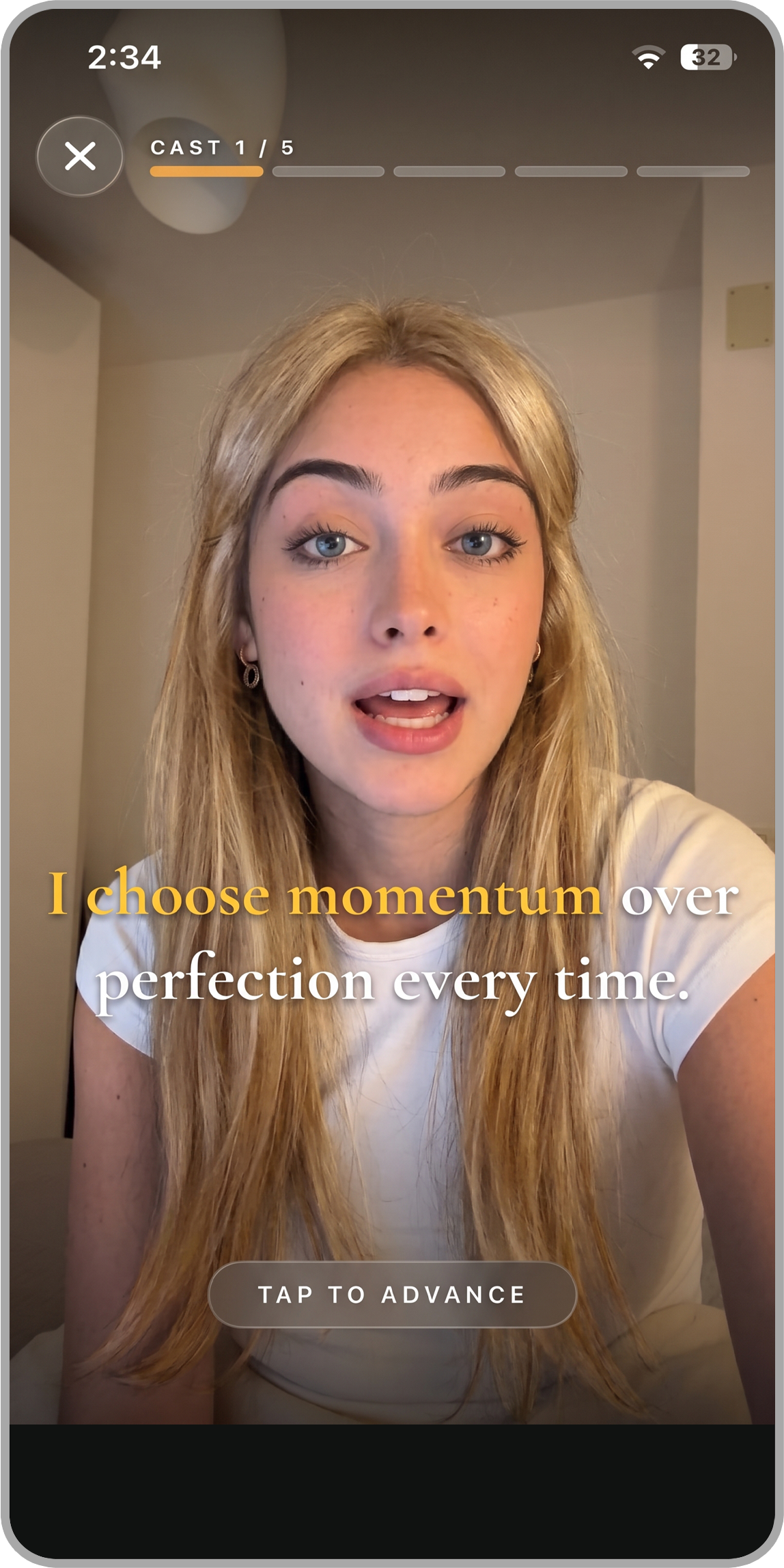
That is why every step above involves your voice or someone speaking to you. And it is why Breakout is built the way it is: the first affirmations app that listens. You speak your spells out loud and on-device speech recognition verifies every word, so the morning session is either cast or it is not. There is no version where you skim the list and count it. Speak it, hear it, repeat it. The streak keeps the score.
A silent routine is unfalsifiable, and unfalsifiable routines quietly become nothing. A spoken one leaves a record.
What to expect in the first 66 days
Lally and colleagues (2010) tracked new habits in the real world and found behaviours became automatic after a median of 66 days, with a range of 18 to 254. Two things in that study matter for your mornings.
First, the ramp is normal. Weeks one to three run on novelty, weeks four to eight are where it feels flat and most people quit. That flat stretch is not failure, it is the groove being carved.
Second, missing a single day did not measurably hurt automaticity. One chaotic morning changes nothing. Two in a row is the real threat, so the only rule is: never miss twice.
Keep the routine boring on purpose. Same lines, same cue, same ten minutes. Consistency is the magic.
The bottom line
Ten minutes, four moves: settle, speak, hear, repeat. Anchor it to something you already do, keep the set small, and let your voice do the work the scroll never will. The best morning affirmation routine is not the most impressive one. It is the one still running in week ten.
Breakout is a personal development tool, not therapy or medical care.
Sources
- Gollwitzer, P. M., & Sheeran, P. (2006). Implementation intentions and goal achievement: A meta-analysis of effects and processes. Advances in Experimental Social Psychology, 38, 69-119.
- MacLeod, C. M., Gopie, N., Hourihan, K. L., Neary, K. R., & Ozubko, J. D. (2010). The production effect: Delineation of a phenomenon. Journal of Experimental Psychology: Learning, Memory, and Cognition, 36(3), 671-685.
- Lally, P., van Jaarsveld, C. H. M., Potts, H. W. W., & Wardle, J. (2010). How are habits formed: Modelling habit formation in the real world. European Journal of Social Psychology, 40(6), 998-1009.
Keep reading: When is the best time to say affirmations? · How to make affirmations a daily habit · How many affirmations should you say a day? · Why do affirmations work better out loud?
Frequently asked
How long should a morning affirmation routine be?
About ten minutes. Long enough to settle, speak your affirmations out loud, listen, and repeat them back. Short enough to survive a busy morning. A routine you can finish before your coffee cools is a routine you will still have in two months.
What should a morning affirmation routine include?
Four things: a minute to arrive, a spoken pass through a small set of affirmations, a listening block, and a second spoken pass. The order matters less than the mechanic. If your voice is not involved, it is reading, not practice.
How many affirmations should I say in the morning?
Three to seven. A small set said with focus beats a long list said on autopilot. Pick lines that are specific and believable, and keep the same set for weeks so the repetition can do its work.
Do affirmations have to be done in the morning?
No. Morning is the best default because it is the most protected window and your day has not set your mood yet, but evening works too. The best slot is the one you will repeat tomorrow. Consistency beats the clock.
Can I do my affirmation routine during my commute?
Only if you can speak out loud there. The routine runs on your voice, so a crowded train is the wrong venue. A car works. If mornings are impossible, move the whole routine to a private slot rather than downgrading it to silent reading.