Habit & ritual
How often should you say affirmations?
Once a day, every day. That is the honest answer to how often you should say affirmations. One short spoken session daily beats a long session twice a week, because repetition spread across days holds and repetition crammed into one sitting fades. Twice a day is fine if you want it. The only cadence that reliably fails is the occasional big push.

- Habit
- Consistency
Most people get the count question right and the cadence question wrong. They pick good lines, say them for nine days in a row, miss a weekend, and never come back. Frequency is where affirmation practices actually die.
How often should you say affirmations?
Once a day, out loud, every day. If you want a number for how often you should say affirmations, that is it. One short session, three to seven lines, spoken at roughly the same point in your day. Ten minutes covers it.
The instinct to do more is understandable and mostly wrong. A ninety minute Sunday session does less than nine minutes on nine days, because your brain does not weigh repetition by volume. It weighs it by how many separate occasions the same thing came back. Spread the reps out and they stack. Pile them into one sitting and most of them are wasted on a brain that already heard the line four seconds ago.
So the answer is not "as often as possible." It is "a small amount, on more days."
Why spaced reps beat cramming
This is one of the oldest and best supported findings in psychology, and it is not specific to affirmations. It applies to anything you are trying to make stick.
Donovan and Radosevich (1999) meta-analysed 63 studies of spaced versus massed practice, covering 112 effect sizes, and found a mean weighted effect of d = 0.46 in favour of spacing. Same total practice time, split across sessions instead of stacked into one, produced meaningfully better performance.
Cepeda and colleagues (2006) went further and pulled together 839 assessments of distributed practice across 317 experiments, published in Psychological Bulletin. Their conclusion was not just that spacing helps, but that the gap between study sessions and the length of time you want the material to hold are linked. The longer you want something to last, the more the reps need to be spread out.
Translate that into your practice. You are not trying to remember an affirmation for an hour. You are trying to change a line you have been telling yourself for fifteen years. That is the longest possible retention interval, which means the widest possible spacing, which means every day for a long time rather than a huge push once a month.
The cadence table
| Cadence | What actually happens | Verdict |
|---|---|---|
| Once a day, out loud | Reps land on separate days, so each one counts. Small enough to survive a bad week. No decision required. | The default. Start here. |
| Twice a day (morning and night) | Reinforces without much added cost, and the evening pass tends to be the more honest one. Only works if the morning one is already automatic. | Good upgrade, not a starting point. |
| Three to four days a week | Every non-day is a decision, and decisions lose to fatigue. The gaps also let the old line run unopposed. | Fragile. Drifts to zero. |
| One long weekly session | Massed practice. Most of the reps land on a brain that just heard the line, so they add duration, not effect. | The worst use of the same total time. |
| Random bursts when motivated | Motivation arrives after progress, not before it, so this cadence waits on the thing it is supposed to produce. | Not a practice. |
| Marathon sessions, 30+ lines | Attention runs out before the list does. Late reps are recitation. | Dilutes the good reps. |
If you are still deciding how many lines belong in each session, how many affirmations to say a day covers the count. This piece is only about the calendar.
What if you miss a day?
Almost nothing happens. This is worth knowing, because the belief that one slip ruins a streak is what turns one missed day into a finished practice.
Lally and colleagues (2010) tracked people building new daily habits in real life and found that behaviours became automatic after a median of 66 days, with a range from 18 to 254. Buried in the same data is the more useful finding: missing a single day had no measurable effect on the automaticity curve. The habit kept forming.
What does damage it is the second miss. One skipped day is noise. Two in a row is a new pattern. So the only rule worth holding is the simple one. Never miss twice.
That also means you should build the smallest version you will not skip. A ten minute session you keep is worth more than a forty minute session you abandon in week three. How to make affirmations a daily habit covers anchoring the session to a cue you already have, which is the part that makes daily realistic.
Consistency beats intensity, but only if you speak
Here is the part that decides whether any of this frequency advice matters. You can hit a perfect daily cadence for two months and get very little, if the reps are silent.
MacLeod and colleagues (2010) documented the production effect: words spoken aloud are recalled roughly 10 to 25 percent better than the same words read silently. Your brain files the two differently. A read affirmation is a thought you had. A spoken one is a thing that happened, with your own voice as the evidence.
That gap compounds daily. Sixty silent sessions and sixty spoken ones are not the same practice run twice. They are two different practices, and only one of them leaves a trace.
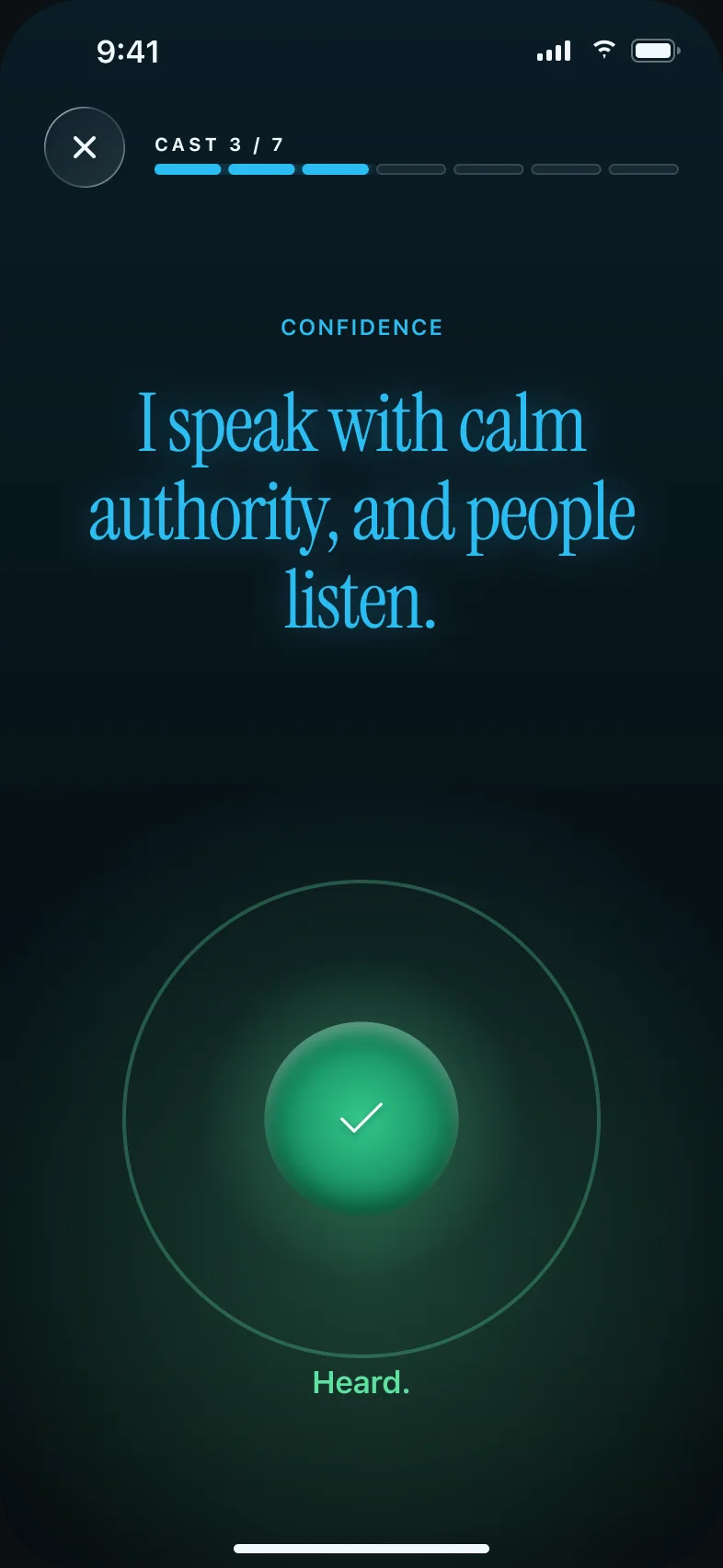
It is also why silent practices are so easy to quietly abandon. There is nothing to check. You cannot tell the difference between a day you skimmed the list and a day you meant it, so the streak becomes a story you tell yourself. This is exactly what Breakout is built to remove. It is the first affirmations app that listens. You cast your spells out loud and on-device speech recognition verifies every word, so a day is either cast or it is not. The count is real because the app heard it.
Speak it, hear it, repeat it. If you want the words running on the days between sessions, spoken affirmations over frequency-tuned audio are the passive layer. Positive Brainwashing supplements the practice. It never replaces the part where you talk.
The bottom line
Once a day, out loud, every day, for longer than feels reasonable. Add a second session only after the first is automatic. Keep it small enough that a bad week cannot kill it. Miss one day if you have to, and never miss two.
The people who get results from affirmations are almost never the ones who did the most in a sitting. They are the ones who were still doing it in month four. Consistency is the magic. If you want honest ranges on the timeline, how long affirmations take to work lays them out, and the best time to say affirmations makes the case for each window.
Breakout is a personal development tool, not therapy or medical care.
Sources
- Donovan, J. J., & Radosevich, D. J. (1999). A meta-analytic review of the distribution of practice effect: Now you see it, now you don't. Journal of Applied Psychology, 84(5), 795-805.
- Cepeda, N. J., Pashler, H., Vul, E., Wixted, J. T., & Rohrer, D. (2006). Distributed practice in verbal recall tasks: A review and quantitative synthesis. Psychological Bulletin, 132(3), 354-380.
- Lally, P., van Jaarsveld, C. H. M., Potts, H. W. W., & Wardle, J. (2010). How are habits formed: Modelling habit formation in the real world. European Journal of Social Psychology, 40(6), 998-1009.
- MacLeod, C. M., Gopie, N., Hourihan, K. L., Neary, K. R., & Ozubko, J. D. (2010). The production effect: Delineation of a phenomenon. Journal of Experimental Psychology: Learning, Memory, and Cognition, 36(3), 671-685.
Keep reading: How many affirmations should you say a day? · How to make affirmations a daily habit · When is the best time to say affirmations? · How long do affirmations take to work?
Frequently asked
How often should you say affirmations?
Once a day, out loud, at roughly the same point in your day. That is the cadence with the best evidence behind it and the best odds of surviving a busy week. Twice a day is a fine upgrade once the once-a-day version is automatic.
Is it better to say affirmations once a day or several times a day?
Once a day done every day beats three times a day done sporadically. Frequency inside a single day matters far less than frequency across days. If you want a second session, add it after the first one has run unbroken for a few weeks.
Can you say affirmations too much?
You can dilute them. Long marathon sessions add reps without adding attention, and repetition you are not really present for stops registering. A focused handful of lines said once with belief does more than fifty said on autopilot.
What happens if I skip a day of affirmations?
Almost nothing. Habit research found that a single missed day had no measurable effect on how automatic a behaviour became. Two in a row is the actual risk, because that is where the practice quietly ends. Never miss twice.
How many days a week should I do affirmations?
Seven. Not because six is useless, but because a daily practice needs no decision and a five-day practice needs one every morning. Deciding is the part that fails first, so remove it.