Affirmations by goal
What are the best affirmations for discipline?
The best affirmations for discipline are not about trying harder. They are about who you are and what you set up. Research on real world self control found that effortful restraint barely predicted whether people reached their goals. Removing the fight did. So the lines worth casting are about identity, environment, and returning after a miss, said out loud, daily.

- Discipline
- Affirmations
What are the best affirmations for discipline?
The best affirmations for discipline are the ones about identity and setup, not the ones about effort. "I am becoming someone who finishes what I start" is a claim you can act on tomorrow. "I have unlimited willpower" is a feeling you cannot summon on demand, and the research says you probably do not need it anyway.
This matters because most discipline advice, and most discipline affirmations, aim at the wrong moment. They aim at the fight. The evidence points somewhere less dramatic.
Discipline is not the muscle you think it is
Milyavskaya and Inzlicht (2017) followed 159 undergraduates for a week, pinging them six times a day to record their goals, their temptations, how hard they were resisting, and how depleted they felt. It is one of the few studies that watched self control happen in real life instead of in a lab.
The finding was uncomfortable for the willpower industry. Effortful self control was unrelated to goal attainment across every analysis. The people who white-knuckled their way through temptation were not the people who hit their goals. What predicted success was experiencing fewer temptations in the first place. Temptation drove depletion, and depletion drove failure.
Read that again, because it reframes the whole category. Discipline, as measured in the wild, looks less like resisting well and more like arranging your life so there is less to resist.
That does not make affirmations useless here. It changes what they should say. A discipline affirmation that glorifies the struggle is aimed at the one variable that did not matter. A discipline affirmation about who you are, and about what you have already decided, aims at the variables that did.
What you believe about your own willpower does some of the work
There is a second thread worth knowing about, and it comes with a caveat.
Job, Dweck and Walton (2010) proposed that whether willpower runs out depends partly on whether you believe it runs out. In their original studies, people who did not view self control as a limited resource showed no drop in performance after a draining task. A follow up, Job, Walton, Bernecker and Dweck (2015), tracked students longitudinally and found that a nonlimited theory predicted better time management, less procrastination, less impulsive spending and better grades, specifically for students facing high demands.
Here is the honest part. A preregistered replication by Carruth, Ramos and Miyake (2023, n = 187) ran the original procedure with methodological improvements and found neither the ego depletion effect nor any moderation by willpower mindset. The original Study 1 had 60 participants. So treat the belief effect as suggestive, not settled.
What survives both the finding and the failed replication is simpler and safer to stand on: the sentence you carry about your own capacity is a live variable, and it is one of the very few in this whole picture that you can change today by saying something different.
What discipline affirmations can and cannot do
Here is the honest ranking of what actually moves discipline, and where a spoken affirmation sits in it.
| Lever | What the evidence says | How much it moves discipline |
|---|---|---|
| Removing the temptation before it arrives | Milyavskaya & Inzlicht (2017): fewer temptations predicted goal attainment | Most |
| Same time, same place, every day | Lally et al. (2010): median 66 days to automaticity, range 18 to 254 | A lot |
| What you believe about your own capacity | Job et al. (2015): a nonlimited theory predicted better self regulation under high demand, though a 2023 replication failed | Real but contested, and it is the one you can talk to |
| Saying the line out loud | MacLeod et al. (2010): production effect, roughly 10 to 25 percent better recall than silent reading | Meaningful, and free |
| Keeping the line believable | Wood, Perunovic & Lee (2009, n = 68): oversized lines left low self esteem participants worse off than saying nothing | Decides whether any of the above works |
| Gritting your teeth in the moment | Milyavskaya & Inzlicht (2017): effortful self control was unrelated to goal attainment | Least |
Notice what is at the bottom. The thing most people call discipline is the least predictive item on the list. And notice what the top row means for your affirmations: the strongest line you can cast is often one that settles a decision in advance, so the fight never gets scheduled.
Why these have to be said out loud
You already have a discipline affirmation. You have been casting it for years.
"I have no willpower." "I always quit." "I am just not a morning person." Those are not passing thoughts. They are positions, stated, usually out loud, often to other people, and they get repeated far more than any new line you are about to try. That is the real competition.
You are not going to outvote a spoken position with a silent one.
MacLeod and colleagues (2010) documented the production effect: words spoken aloud are remembered roughly 10 to 25 percent better than words read silently. Forrin and MacLeod (2018) refined it into a gradient, where speaking beat hearing your own recorded voice, which beat hearing someone else, which beat silent reading. Your own voice, live, sits at the top.
There is a second reason, and it is the one that decides whether you still have a practice in March. A silent affirmation cannot be verified. Nobody knows whether you did it, including you, which is exactly why silent practices quietly become nothing. A spoken one is a thing that happened.
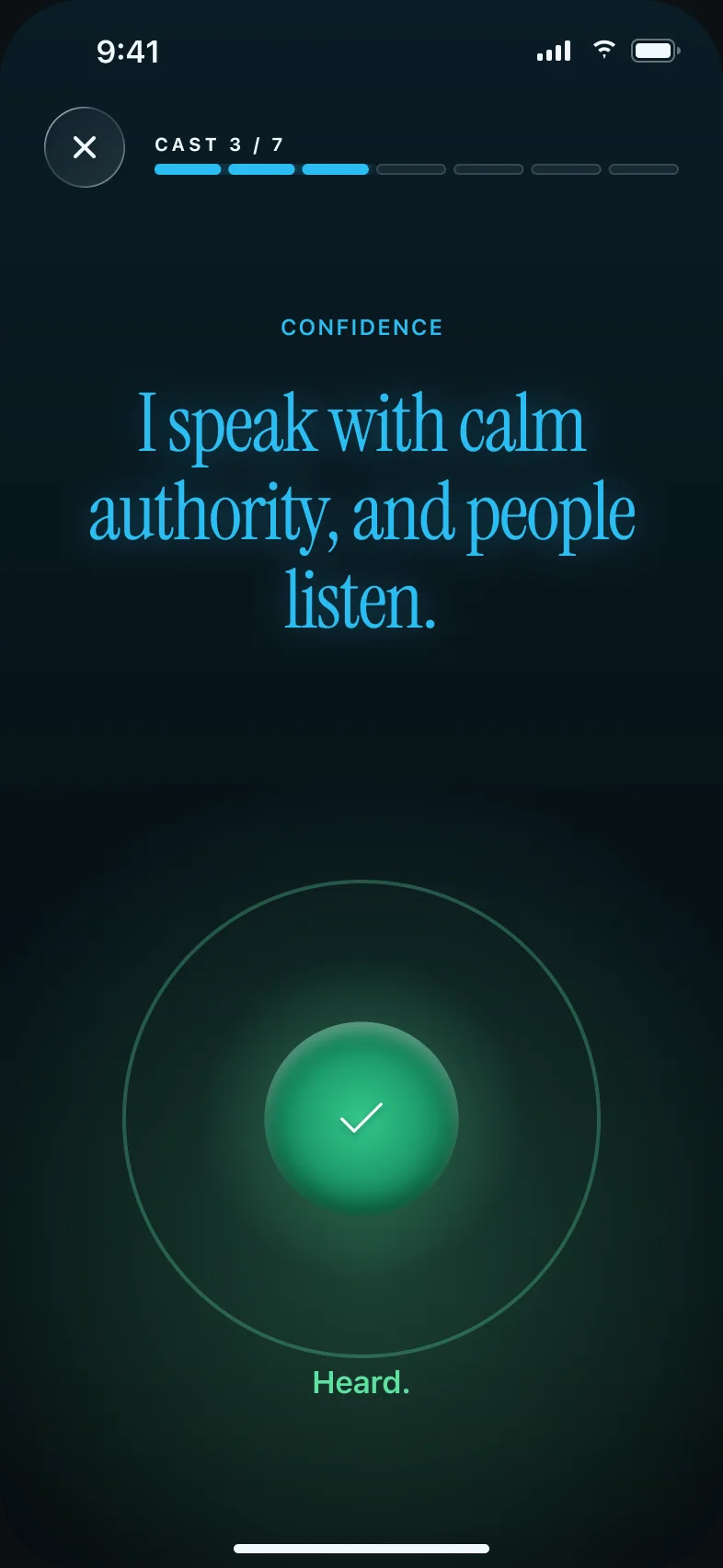
This is the whole idea behind Breakout, the first affirmations app that listens. You do not read your spells, you cast them. On-device speech recognition verifies every word, so the rep either happened or it did not. For a discipline practice specifically, that is the point: you are building the identity of someone who does what they said they would, and the app is the part that can tell.
21 affirmations for discipline, by moment
Grouped by when you will need them, not by theme. Pick three or four, not all 21. Say them out loud.
When you do not feel like it
- I do not need to feel ready. I need to start.
- I am the kind of person who keeps the appointment I made with myself.
- Motivation is a guest. My routine is a resident.
- I have done hard things tired before. I am doing one now.
- The version of me I am building starts in the next five minutes.
When you are setting the day up
- I decide once, in the morning, so I do not have to decide all day.
- I am someone who makes the right thing the easy thing.
- I protect the first hour, because the first hour sets the rest.
- I choose the three things that matter and let the rest wait.
When the temptation is already in front of you
- I do not fight what I can remove.
- I am not the person who does that anymore. That is a settled question.
- I can want it and still not take it.
- This urge has a shelf life. I do not.
When you have already broken the streak
- One missed day is data, not a verdict.
- I never miss twice.
- I am not starting over. I am continuing.
- I forgive fast and return faster.
When it is slow and nobody notices
- I am building something that does not announce itself.
- Consistency is the magic. I show up anyway.
- I keep promises no one is checking.
- I am not behind. I am early in a long thing.
You will notice what is missing. There is no "I have iron discipline" and no "nothing can stop me." Those are the lines that fail the believability test below, and they are aimed at the least predictive variable on the table.
Keep them believable, or skip them
Wood, Perunovic and Lee (2009) had 68 participants repeat a positive self statement. Participants with low self esteem ended up in a worse mood than a control group who said nothing at all. The line was not too positive. It was too far from where they actually stood.
Discipline lines are unusually prone to this, because anyone searching for them is, by definition, in a stretch of not being disciplined. Saying "I am incredibly disciplined" on day three of a broken streak is a claim your own history will immediately contest.
Bridge it instead.
- "I am incredibly disciplined" becomes "I am becoming someone who finishes what I start."
- "I never procrastinate" becomes "I start before I feel ready."
- "I have unlimited willpower" becomes "I do not need willpower for things I have already decided."
The test is simple. Say the line out loud. If your own head immediately answers back, the line is too big. Shrink it until the answer stops coming, then cast that one daily. There is more on this in do you have to believe an affirmation for it to work?
How long before it feels automatic
Lally and colleagues (2010) tracked how long a new daily behaviour took to become automatic. The median was 66 days, with a range from 18 to 254. That is the honest window for the practice becoming a habit, not for your character being rebuilt.
The sequence tends to run in this order. The daily rep gets easier. The internal argument gets quieter. You return faster after a miss. Then, later, other people start describing you as disciplined, which is the only real proof there is.
Missing one day had no measurable effect in Lally's data. Missing two in a row is where practices die, which is why line 15 above is the single most useful thing on the list.
The bottom line
Discipline is less a muscle than a set of decisions you make once, out loud, in advance. The affirmations worth casting are the ones that state who you are and what you have already settled, not the ones that promise a feeling you cannot produce on command.
Your words are powerful. That is why they call it spelling. Pick four lines, cast them out loud tomorrow morning, and remove one temptation while you are at it. Build your set and see what your voice is actually agreeing to. If you want the fuller method, start with the practice or read why spoken affirmations do the work that silent ones cannot.
Breakout is a personal development practice. It is not therapy and not medical care.
Related reading
- Why saying affirmations out loud works better
- How to make affirmations a daily habit
- How often should you say affirmations?
- Can affirmations change your identity?
- What are the best affirmations for confidence?
Sources
- Milyavskaya, M., & Inzlicht, M. (2017). What's so great about self-control? Examining the importance of effortful self-control and temptation in predicting real-life depletion and goal attainment. Social Psychological and Personality Science, 8(6), 603-611.
- Job, V., Dweck, C. S., & Walton, G. M. (2010). Ego depletion, is it all in your head? Implicit theories about willpower affect self-regulation. Psychological Science, 21(11), 1686-1693.
- Job, V., Walton, G. M., Bernecker, K., & Dweck, C. S. (2015). Implicit theories about willpower predict self-regulation and grades in everyday life. Journal of Personality and Social Psychology, 108(4), 637-647.
- Carruth, N. P., Ramos, T., & Miyake, A. (2023). Does willpower mindset really moderate the ego-depletion effect? A preregistered replication of Job, Dweck, and Walton (2010). PLOS ONE, 18(6), e0287911.
- MacLeod, C. M., Gopie, N., Hourihan, K. L., Neary, K. R., & Ozubko, J. D. (2010). The production effect: delineation of a phenomenon. Journal of Experimental Psychology: Learning, Memory, and Cognition, 36(3), 671-685.
- Forrin, N. D., & MacLeod, C. M. (2018). This time it's personal: the memory benefit of hearing oneself. Memory, 26(4), 574-579.
- Wood, J. V., Perunovic, W. Q. E., & Lee, J. W. (2009). Positive self-statements: power for some, peril for others. Psychological Science, 20(7), 860-866.
- Lally, P., van Jaarsveld, C. H. M., Potts, H. W. W., & Wardle, J. (2010). How are habits formed: modelling habit formation in the real world. European Journal of Social Psychology, 40(6), 998-1009.
Frequently asked
What are the best affirmations for discipline?
The ones about identity and setup rather than effort. Lines like "I never miss twice" or "I decide once in the morning so I do not have to decide all day" describe a person and a system. Lines like "I have unlimited willpower" describe a feeling you cannot summon on command.
Can affirmations actually make you more disciplined?
Not directly. Affirmations change the sentence you run on, which changes what you attempt and how fast you return after a miss. The discipline still comes from repetition and environment. The affirmation makes the repetition easier to keep.
Should discipline affirmations be said out loud?
Yes. MacLeod and colleagues (2010) found that speaking words aloud produced roughly 10 to 25 percent better recall than reading them silently. More importantly, a spoken line is a thing that happened. A read one is a thought you had, and it cannot be checked.
Why do my discipline affirmations stop working after a week?
Usually because the line was oversized, or because it was doing all the work alone. An affirmation is one lever. Removing the temptation, fixing the time, and keeping the line believable are the others. Drop any line you do not half believe.
How long until discipline feels automatic?
Lally and colleagues (2010) found a median of 66 days for a new daily behaviour to feel automatic, with a range of 18 to 254. That is the window for the practice, not for your whole life. Missing one day changes little. Missing two in a row is where it dies.