Affirmations by goal
What are the best affirmations for imposter syndrome?
Affirmations for imposter syndrome work only if they answer the actual accusation. The feeling is not a lack of praise, it is a refusal to accept it, so a bigger claim like I am brilliant gets argued down in under a second. Lines that point at evidence hold. Lines that point at talent do not. And they have to be spoken, because the case against you already is.

- Imposter syndrome
- Affirmations
Imposter syndrome is not a shortage of evidence. It is a filing system that throws the evidence out. Which is exactly why most affirmations written for it fail on contact.
Do affirmations for imposter syndrome actually work?
They work when the line is small enough to survive your own cross-examination.
Start with the scale of the thing. Bravata and colleagues (2020) published the first systematic review of impostor syndrome in the Journal of General Internal Medicine, pooling 62 studies and 14,161 participants. Prevalence estimates ranged from 9 to 82 percent depending on which screening tool was used. It was common among both men and women, and across ages from adolescents to late-stage professionals.
Two other findings from that review matter more than the prevalence number. Impostor syndrome is not in the DSM or the ICD-10, so it is a pattern of thought rather than a clinical diagnosis. And at the time of the review, no published studies had evaluated treatments for it. There is no protocol. What there is instead is a well-described mechanism you can work on directly.
That mechanism is what Clance and Imes named in 1978 when they coined the impostor phenomenon: high achievers who privately believe they are intellectual frauds, and who dismiss the evidence against that belief as luck, timing, charm, or someone else's mistake. The evidence arrives. It gets rejected at the door.
So the question is not "does positive self-talk help." It is narrower. Can you say something your own filing system will actually accept?
Why the usual imposter affirmations backfire
Most lines written for this feeling are the exact shape the feeling is built to reject.
"I am brilliant." "I deserve every bit of this." "I am the expert in the room."
Say one of those and watch what happens. Your mind produces a counter-example in half a second, with names and dates attached. You did not fail to plant a belief. You rehearsed the case against yourself, with fresh detail.
This is not a hunch. Wood, Perunovic and Lee (2009) had 68 participants repeat "I am a lovable person" every fifteen seconds for four minutes. Participants with low self-esteem finished in a worse mood than a control group who said nothing at all. The people who needed the sentence most were the people it hurt.
Imposter feelings have a specific signature. The gap between your public record and your private verdict is wide, and you defend the private verdict for a living. A grand affirmation walks straight into that.
The fix is not a louder line. It is a line built out of something you cannot dispute.
Point at the evidence, not the talent
Three kinds of statement your inner critic struggles to argue with.
Facts. "I was invited to this." That happened. You can dislike what it means. You cannot deny it occurred.
Process. "I prepare more than most people in this room." You know whether that is true, and it usually is, because over-preparation is the imposter tax.
Direction. "I am learning to speak before I feel qualified." A claim about where you are heading cannot be falsified by your past.
All three leave the question of whether you are secretly a genius entirely alone. That question is unwinnable. Stop entering it.
The lines to drop, and what to cast instead
| The imposter thought | What it quietly assumes | Say this instead |
|---|---|---|
| "I only got here by luck." | That luck and earned effort cannot both be true at once. | "Luck opened the door. I am the one who walked through it and stayed." |
| "They are going to find me out." | That there is a secret, and that you are it. | "If they look closely, they will find someone who prepares." |
| "Everyone else knows what they are doing." | That confidence and competence are the same signal. | "Their confidence is not evidence. It is a manner." |
| "I cannot take credit, it was the team." | That acknowledging help cancels your contribution. | "It was the team. I was on it, and I carried my part." |
| "I should not speak until I am certain." | That certainty is the entry fee for having a voice. | "I speak up before I feel qualified to speak up." |
| "I am brilliant and I know it." | That the fix for a weak claim is a bigger one. | "I am good at this, and I am still getting better." |
21 affirmations for imposter syndrome, by moment
These are spells, not slogans. Pick the group that matches where the feeling actually hits you, take four or five lines, and cast the same ones daily until they stop feeling like a stretch. If a line is too far ahead of you today, bridge it with "I am learning to."
When someone praises your work
- I can accept this without auditing it.
- They are not easy to impress. That is why this counts.
- I did the work. Taking the credit is part of the work.
- I do not have to feel deserving to say thank you.
When you are the least experienced person in the room
- I was invited. That was not an accident.
- Being new is not the same as being unqualified.
- The people here already know what I do not. They asked me anyway.
- I am the least experienced person here today, and I am still useful here today.
When you are handed something you have never done
- I have learned harder things than this with less help.
- I do not need to be certain to begin.
- I am allowed to be a beginner in public.
- Not knowing yet is the job. It is not a disqualification.
When you start comparing
- I am comparing my inside to their outside.
- Their confidence is not evidence of their competence.
- I only see their result. I lived my whole process.
- There is room for me at this level.
When you want to over-prepare or disappear
- Good enough and delivered beats perfect and hidden.
- I can send it at ninety percent and survive the feedback.
- Preparing more is not the same as being more ready.
- I speak first and edit second.
- If they find me out, what they will find is someone who works.
Say them out loud, because the accusation already is
Here is the part most advice skips.
The imposter case against you is not written down. It is spoken. It runs as a voice in your head, in real time, usually in the two seconds after someone compliments you. You have been prosecuting yourself for years and never once said a word of the defence.
Reading a list of affirmations silently does not answer that. It is the wrong medium for the argument.
MacLeod and colleagues (2010) documented what is now called the production effect: saying a word aloud produces a 10 to 25 percent memory advantage over reading the same word silently. Forrin and MacLeod (2018) ranked the whole gradient. Speaking it yourself beat hearing a recording of your own voice, which beat hearing someone else say it, which beat silent reading. The more of the work is yours, the more of it stays.
Speaking also makes the claim checkable. Say "I was invited, that was not an accident" out loud and you hear yourself say it, in your own voice, without flinching. That is a piece of evidence that did not exist a second ago. Evidence is the only currency this feeling accepts.
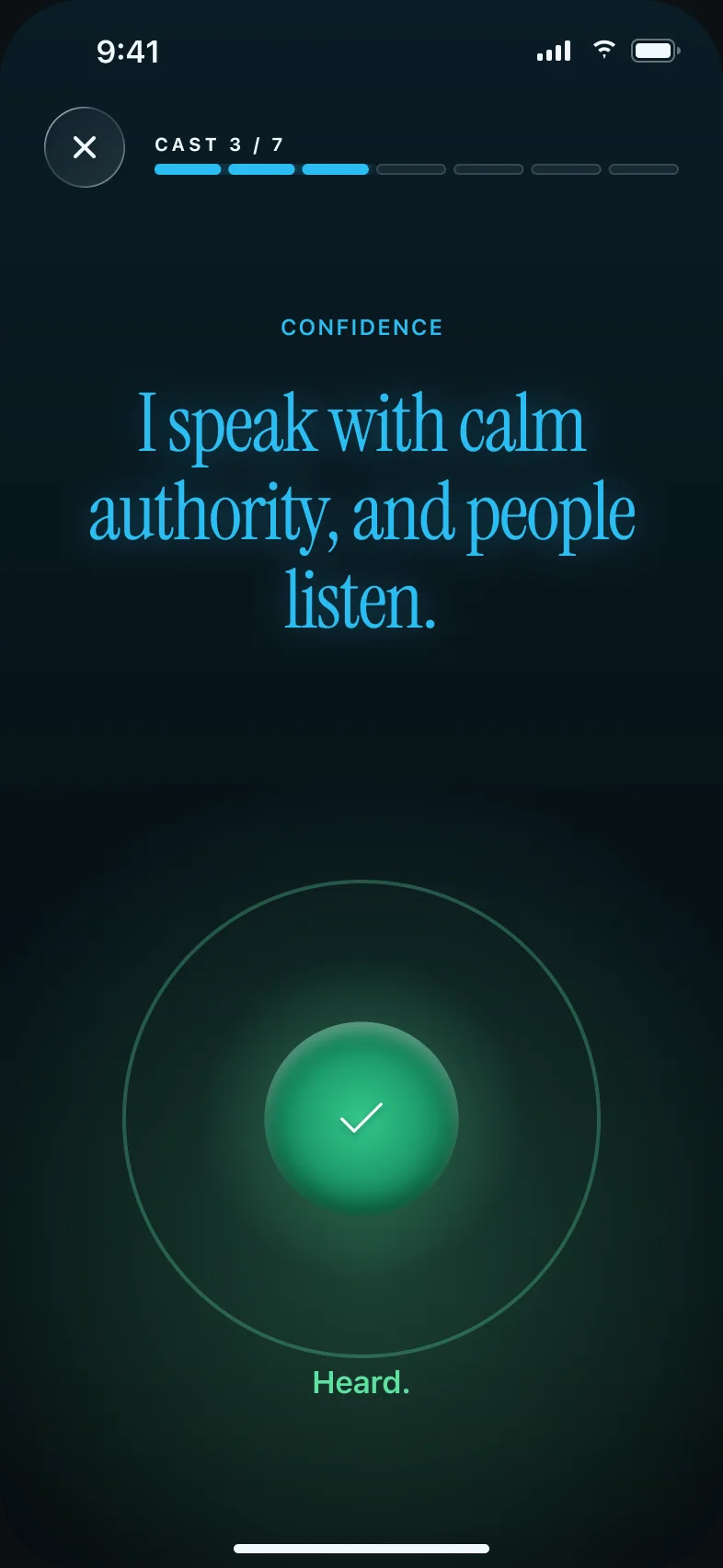
That is the entire premise of Breakout. You do not scroll your affirmations. You cast them. On-device speech recognition listens and verifies every word, so a session you skipped and a session you completed are not the same thing. A silent practice is unfalsifiable, which is exactly how it quietly becomes nothing.
Your words are spells. That is why they call it spelling. Cast them on purpose.
How long before it shifts
Weeks, not days.
Lally and colleagues (2010) tracked how long a new behaviour took to become automatic and found a median of 66 days, with a range from 18 to 254. Imposter feelings have usually had a decade of daily rehearsal. A fortnight of counter-evidence is not a fair fight.
The practical version is about ten minutes a day. Four or five lines, spoken, same time each morning, before the day gives you fresh material to misread. That is the practice, and consistency is the whole of the magic.
A last honest note. The feeling rarely disappears. What changes is how much authority it has. You stop needing to win the argument about whether you belong, and start speaking before it is settled. That is enough. Most of the people you are intimidated by are doing exactly that.
Keep reading
- Do you have to believe an affirmation for it to work?
- Why saying affirmations out loud works better
- Can affirmations backfire?
- What are the best affirmations for confidence?
- How to write affirmations that actually work
Browse the full affirmation library for spell packs by theme.
Sources
- Clance, P. R., & Imes, S. A. (1978). The impostor phenomenon in high achieving women: Dynamics and therapeutic intervention. Psychotherapy: Theory, Research & Practice, 15(3), 241-247.
- Bravata, D. M., Watts, S. A., Keefer, A. L., et al. (2020). Prevalence, predictors, and treatment of impostor syndrome: A systematic review. Journal of General Internal Medicine, 35(4), 1252-1275.
- Wood, J. V., Perunovic, W. Q. E., & Lee, J. W. (2009). Positive self-statements: Power for some, peril for others. Psychological Science, 20(7), 860-866.
- MacLeod, C. M., Gopie, N., Hourihan, K. L., Neary, K. R., & Ozubko, J. D. (2010). The production effect: Delineation of a phenomenon. Journal of Experimental Psychology: Learning, Memory, and Cognition, 36(3), 671-685.
- Forrin, N. D., & MacLeod, C. M. (2018). This time it's personal: The memory benefit of hearing oneself. Memory, 26(4), 574-579.
- Lally, P., van Jaarsveld, C. H. M., Potts, H. W. W., & Wardle, J. (2010). How are habits formed: Modelling habit formation in the real world. European Journal of Social Psychology, 40(6), 998-1009.
Breakout is a personal development tool, not therapy and not a medical product. Imposter syndrome is not a clinical diagnosis, but if what you are carrying feels heavier than the description here, speak to a professional. Individual results vary.
Frequently asked
What are the best affirmations for imposter syndrome?
The best ones point at evidence rather than talent. Lines like I was invited, that was not an accident, or being new is not the same as being unqualified, hold up under scrutiny. I am brilliant does not, because imposter feelings are built on discounting exactly that kind of claim.
Why do affirmations make my imposter syndrome worse?
Because you are already an expert at discounting evidence in your own favour. A grand line hands your inner critic something easy to knock down. In a 2009 study, people with low self-esteem who repeated I am a lovable person ended up in a worse mood than a control group who said nothing. Make the line smaller and harder to argue with.
Is imposter syndrome a mental health condition?
No. Bravata and colleagues (2020) note that impostor syndrome appears in neither the DSM nor the ICD-10. It is a pattern of thought, not a diagnosis. That is also why affirmations are a reasonable self-directed practice here and not a substitute for professional support if you need it.
How common is imposter syndrome?
Common enough that the range is almost comic. A 2020 systematic review of 62 studies and 14,161 people found prevalence estimates from 9 to 82 percent, depending entirely on the screening tool used. It showed up in men and women, in students and in late-career professionals.
Should I say imposter syndrome affirmations out loud?
Yes. Silent reading is the weakest way to move a belief. Speaking a phrase aloud produces a 10 to 25 percent memory advantage over reading it silently, and the accusation you are answering is already running as a voice in your head. You will not outvote a spoken position with a silent one.