Affirmations by goal
What are the best affirmations for self-love?
Affirmations for self-love work, but not the ones you have seen. The most popular self-love line in circulation, I am a lovable person, is the exact statement that made people with low self-esteem feel worse in a 2009 study. What works is smaller, more believable, and said out loud, where you can hear yourself make the claim.

- Self-love
- Affirmations
"Affirmations for self-love" is one of the most searched affirmation phrases there is. It is also the category where the standard advice does the most damage, because the lines people repeat are the biggest ones, and the people repeating them usually believe them the least.
Do affirmations for self-love actually work?
Yes, under one condition: you have to half believe the line before you say it.
Here is the uncomfortable part. In 2009, Wood, Perunovic and Lee ran a study with 68 participants who repeated the phrase "I am a lovable person" every fifteen seconds for four minutes. For participants with low self-esteem, mood afterward was worse than a control group who said nothing at all. The sentence that sells the most self-love journals is the sentence that misfired in the lab.
The mechanism is simple. A claim far outside what you accept does not get absorbed. It gets argued with. You say "I love myself completely," and some part of you immediately produces the counter-evidence. You just rehearsed the counter-evidence.
That does not mean self-love is empty. The correlation is one of the sturdier findings in the field. Zessin, Dickhäuser and Garbade (2015) pooled 79 samples and 16,416 people and found a relationship between self-compassion and wellbeing of r = .47. That is a large effect by the standards of this literature. Self-compassion is worth building. The way most people try to build it is what fails.
Self-love is not self-esteem, and the difference decides your lines
Self-esteem is a rating. It answers "how good am I?" and it moves every single time you win or lose something. Which means it is at its lowest exactly when you need it most.
Self-compassion answers a different question: "how do I treat myself when I have just fallen short?" It does not require a favourable verdict. It survives a bad week.
This is also why the "self-love makes you soft" objection does not hold up. Breines and Chen (2012), across four experiments, found that participants placed in a self-compassionate frame after a failure spent more time preparing for a second attempt than those given a self-esteem boost or a neutral distraction. Being on your own side made people try harder, not less.
So write your lines to answer the second question, not the first. Not "I am wonderful." Rather, "I am on my own side, even today."
The lines to skip, and what to say instead
This table is the whole article in one place.
| The common line | Why it stalls | Say this instead |
|---|---|---|
| "I am a lovable person." | The exact phrase that backfired in Wood et al. (2009) for low self-esteem. | "I am learning to treat myself like someone worth loving." |
| "I love myself completely." | A total claim. One exception collapses it. | "I am on my own side, even today." |
| "I am perfect exactly as I am." | Contradicts everything you are actively trying to change. | "I can want to grow and still be worth something now." |
| "I am beautiful." | Puts your worth back on your appearance, which is the original problem. | "My body is not a project. It is where I live." |
| "I forgive myself for everything." | Too large to mean anything, so it means nothing. | "The version of me who did that had less than I have now." |
| "I am enough." | True, but abstract. There is nothing to hold. | "I do not have to earn a place in my own life." |
The pattern in the right-hand column: smaller scope, present tense you can defend, and a bridge phrase ("I am learning to," "I can") wherever the claim is still a stretch. That is how you keep the line believable without lowering the target.
21 affirmations for self-love worth saying out loud
Pick five. Not twenty-one. Say the same five every day for a month, out loud, and let them get worn in.
When you have just messed something up
- I made a mistake. That is not the same as being one.
- I am allowed to be a work in progress.
- I can be honest about this without being cruel about it.
- I speak to myself the way I would speak to someone I respect.
- I hold myself to standards, not to sentences.
About your body
- My body is not a project. It is where I live.
- I am learning to look at myself without a verdict attached.
- I take care of this body because it is mine, not because it is failing.
- I can want to change something and still respect it today.
About your past
- I have forgiven other people for more than this.
- The version of me who did that had less than I have now.
- I am not required to keep paying for something I already stopped doing.
- I am becoming someone who does not need the old story to stay.
About your worth
- My worth is not a score I defend every morning.
- I am worth the same on the days I get nothing done.
- I do not have to earn a place in my own life.
- I am learning to believe good things about myself without permission.
About boundaries
- I can disappoint someone and still be a good person.
- No is a full sentence, and I am allowed to use it.
- I do not owe access to everyone who asks.
- I am someone who protects their own peace.
Every one of these is identity-based and sized to be believable. If one of them still makes you flinch, add "I am learning to" in front of it and try again. For the full formula, see how to write affirmations that work.
Why saying them out loud is the part that matters
You could read that list and feel something. Most people do. Then nothing changes, because reading a sentence and making a claim are two different acts.
Memory research is blunt about the gap. MacLeod and colleagues (2010) documented the production effect: material read aloud is remembered 10 to 25 percent better than the same material read silently. Forrin and MacLeod (2018) then sorted the channels, and the order held every time. Speaking beats hearing your own recorded voice, which beats hearing someone else, which beats silent reading.
For self-love specifically, there is a second thing going on. The voice that talks you down is a spoken voice. It has tone. It has phrasing you would recognise anywhere. You are not going to outvote a spoken position with a silent one.
And there is a practical problem with silent practice that nobody mentions. It cannot be checked. You cannot tell the difference between a week where you meant it and a week where your eyes moved across the words on the way to something else. A silent practice is unfalsifiable, which is exactly why it quietly becomes nothing.
How to actually run this
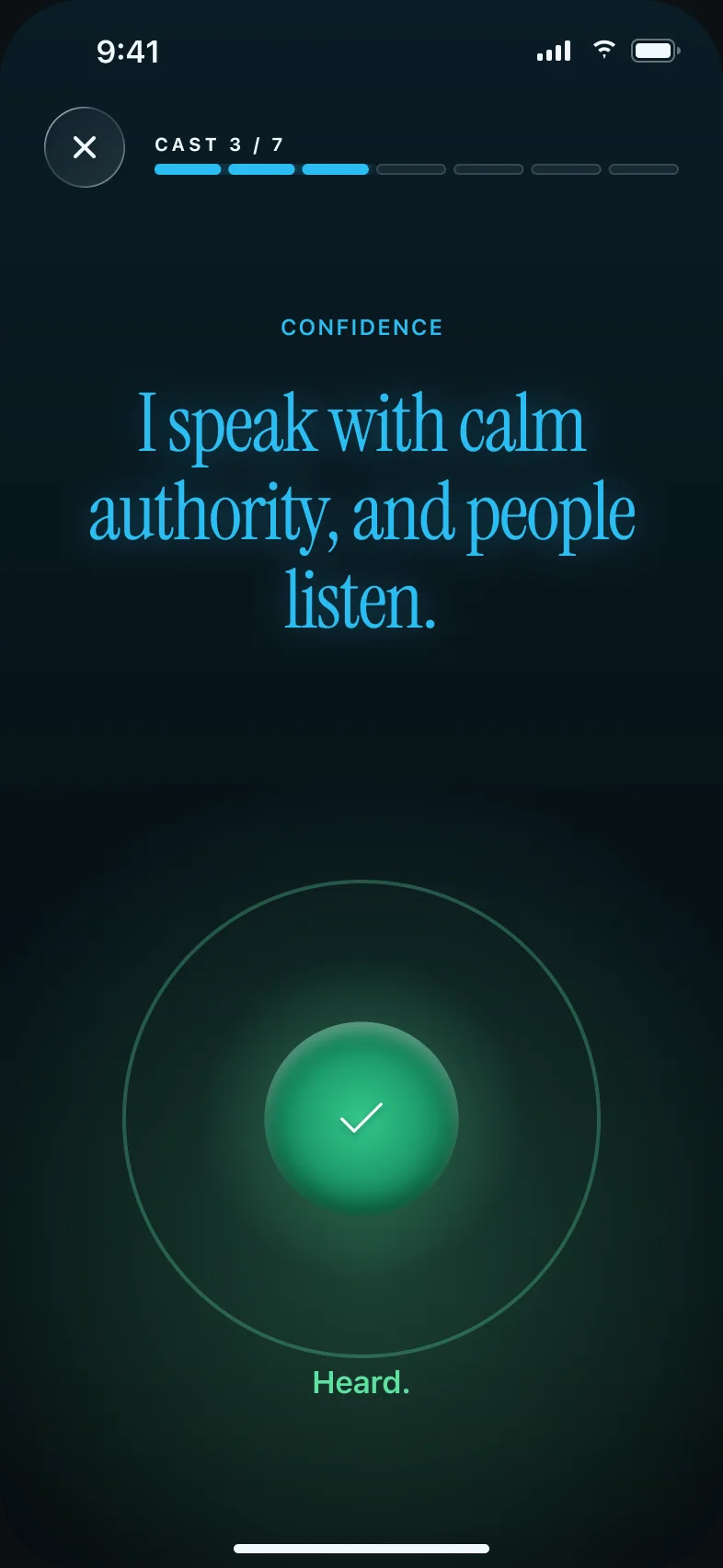
Breakout is the first affirmations app that listens. You cast the spell out loud and on-device speech recognition verifies every word. Not a checkbox. The actual sentence, out of your actual mouth, confirmed. A read affirmation is a thought you had. A spoken one is a thing that happened.
Four moves, about ten minutes:
- Pick five lines from above, or write your own in Rewire. Keep them believable.
- Speak each one out loud, once, slowly enough to mean it.
- Hear it. Layer Positive Brainwashing underneath while your hands are busy. It is the supplement, not the practice.
- Repeat it tomorrow. Lally et al. (2010) put the median time to automaticity at 66 days, range 18 to 254. One missed day had no measurable effect. Never miss twice.
Consistency is the magic. Pull lines from the affirmation library when you run dry, and build the daily version in the practice.
Your words are powerful. That is why they call it spelling. The voice in your head has been casting the other version of this for years, out loud, in your own accent. It is your turn.
Related reading
- Do you have to believe an affirmation for it to work?
- Can affirmations be harmful or backfire?
- How to stop negative self-talk
- Do affirmations for confidence actually work?
- Why do affirmations work better out loud?
Pillars: Affirmation library · Spoken affirmations · The practice
Sources
- Wood, J. V., Perunovic, W. Q. E., & Lee, J. W. (2009). Positive self-statements: power for some, peril for others. Psychological Science, 20(7), 860 to 866.
- Zessin, U., Dickhäuser, O., & Garbade, S. (2015). The relationship between self-compassion and well-being: a meta-analysis. Applied Psychology: Health and Well-Being, 7(3), 340 to 364.
- Breines, J. G., & Chen, S. (2012). Self-compassion increases self-improvement motivation. Personality and Social Psychology Bulletin, 38(9), 1133 to 1143.
- MacLeod, C. M., Gopie, N., Hourihan, K. L., Neary, K. R., & Ozubko, J. D. (2010). The production effect: delineation of a phenomenon. Journal of Experimental Psychology: Learning, Memory, and Cognition, 36(3), 671 to 685.
- Forrin, N. D., & MacLeod, C. M. (2018). This time it's personal: the memory benefit of hearing oneself. Memory, 26(4), 574 to 579.
- Lally, P., van Jaarsveld, C. H. M., Potts, H. W. W., & Wardle, J. (2010). How are habits formed: modelling habit formation in the real world. European Journal of Social Psychology, 40(6), 998 to 1009.
If the way you talk to yourself is heavy enough that these lines feel out of reach, that is worth taking to a professional rather than a longer list. Breakout is a personal development practice, not therapy and not medical care. It does not diagnose, treat, or cure anything.
Frequently asked
What are the best affirmations for self-love?
The best ones are specific, believable today, and said out loud. Lines like I made a mistake, that is not the same as being one, or I do not have to earn a place in my own life, land better than I love myself completely. The grand version is the one that tends to backfire.
Why do self-love affirmations make me feel worse?
Because the gap between the claim and what you believe is too wide. In a 2009 study, people with low self-esteem who repeated I am a lovable person ended up in a worse mood than people who said nothing. The fix is not a bigger line. It is a smaller one you can actually agree with.
Is self-love the same as self-esteem?
No. Self-esteem is a rating, which means it moves every time you succeed or fail. Self-love, in the self-compassion sense, is how you treat yourself when you have just failed. That is why it holds up on bad days and a rating does not.
Does self-love make you complacent?
The research points the other way. Across four experiments, Breines and Chen (2012) found that people put in a self-compassionate frame after a failure spent more time preparing for a second attempt, not less. Being on your own side is not the same as letting yourself off the hook.
How long do self-love affirmations take to work?
Expect weeks, not days. Habit research puts the median time to automaticity at 66 days, with a range from 18 to 254. Speaking the same handful of lines daily is what compounds. A month of casual scrolling past them does close to nothing.