How-to & getting started
Should affirmations be present or future tense?
Use the present tense. Affirmations work best as statements about who you are now, because future tense parks the change with a version of you that does not exist yet, and your brain treats that person like a stranger. The exception is when the present tense feels like a lie. Then use a present-tense bridge, I am becoming, I am learning to, so the line stays believable. Then say it out loud.

- Affirmations
- How-to
Nearly every affirmation guide tells you to use the present tense, and almost none of them tell you why, or what to do when "I am confident" feels like a flat lie. Here is the honest version.
Should affirmations be present or future tense?
Present tense, by default. An affirmation is not a plan, it is a description. You are trying to change what you believe about who you are right now, and the present tense is the only form that makes that claim.
Future tense does something subtly different. "I will be confident" is a promise, and a promise can be renegotiated every single morning without ever technically being broken. There is always more future left. The line never comes due, so nothing has to change today.
There are three real reasons the present tense wins, and one honest exception. Take them in order.
Why future tense affirmations lose their grip
The first reason is that your future self is, cognitively speaking, a bit of a stranger.
Hershfield and colleagues (2011) tested this directly. Across four studies, working-age adults who interacted with realistic age-progressed renderings of their own future faces were willing to allocate roughly 33 percent more of their paycheck to a retirement account than people who saw their current face. Meeting the future version of yourself closed the gap. Until it closed, people were making decisions about that person the way you would make decisions about an acquaintance.
Now read your affirmation again. "I will be someone who speaks up in meetings." Who is that about? Not you. It is about a person you have never met, who does not have to show up today, and who your brain is not especially invested in.
Present tense removes the middleman. "I speak up when it matters" is a claim about the person who is standing here holding the phone. It can be acted on before lunch.
The "I will" trap
The second reason is more surprising. Declaring your future intention is not just weaker than the present tense, it is weaker than simply asking yourself a question.
Senay, Albarracín and Noguchi (2010), in Psychological Science, ran four experiments on the grammar of self-talk. In the first, fifty-three students spent one minute either thinking whether they would work on an anagram task or thinking that they would. The "whether" group then solved an average of 2.60 anagrams out of ten, against 1.84 for the "would" group, roughly 40 percent more. In the follow-up, participants who wrote the words Will I twenty times as part of a fake handwriting study outperformed everyone who wrote I will, and the effect ran through intrinsic motivation.
The takeaway is not that you should turn every affirmation into a question. It is that "I will" is a surprisingly hollow form. It sounds like commitment and behaves like filler. If future-tense declaration cannot beat a handwriting exercise, it is not the sentence you want carrying your practice.
The five forms, compared
| Form | Example | What it actually does | Use it |
|---|---|---|---|
| Future tense | "I will be confident." | Assigns the trait to a future self you do not identify with yet. Renegotiable daily. | Rarely. Only for dated, external goals. |
| Present tense, believable | "I speak up when it matters." | Reads as a description of who you are. Nothing to argue with. | Default. This is the one. |
| Present tense, oversized | "I am the most confident person in any room." | Trips your internal skeptic. Can leave you feeling worse if you already doubt it. | Not until it is close to true. |
| Present progressive bridge | "I am becoming someone who speaks up." | Present tense, honest about the gap, keeps belief intact. | When the plain present tense feels like a lie. |
| Interrogative | "Will I speak up today?" | Pulls up your own reasons instead of issuing an order. | Before a specific task, not as an identity line. |
When the present tense is the wrong call
Here is the exception, and it matters more than the rule.
Present tense only works if you can hold the line without flinching. Wood, Perunovic and Lee (2009) found that participants with low self-esteem who repeated "I am a lovable person" ended up in a worse mood than people who said nothing at all. A present-tense claim you actively disbelieve does not slide past the skeptic. It wakes it up, and the skeptic answers with a list of counterexamples.
So the choice is not really present versus future. It is believable present versus unbelievable present, and the fix is a bridge, not a tense change.
- "I am confident" becomes "I am becoming someone who trusts their own judgment."
- "I am wealthy" becomes "I am learning to handle money like someone who keeps it."
- "I am calm" becomes "I choose steadiness, one moment at a time."
All three are still present tense. All three are true the moment you say them, because becoming, learning and choosing are things you are doing right now. That is the whole trick. If you want the full ladder, do you have to believe an affirmation for it to work walks it step by step, and how to write affirmations that work has the formula.
Genuine future tense has exactly one honest job: dated, external plans. "I will send the application on Tuesday." That is a commitment with a deadline attached, and deadlines belong in the future. It is a task, not a spell.
Tense matters less than whether you say it out loud
Now the part that outranks all of this.
You can spend a week perfecting the grammar of six sentences and get nothing, because you read them. MacLeod and colleagues (2010) documented the production effect: words spoken aloud are recalled roughly 10 to 25 percent better than the same words read silently. Your brain files the two differently. A read affirmation is a thought you had. A spoken one is a thing that happened, with your own voice as the evidence.
That distinction is why the tense debate is downstream. Present tense is a claim, and a claim is only worth something if it gets made. Silently, nothing is claimed. Nothing is heard. Nothing can be checked, which is also why silent practices are so easy to quietly abandon.
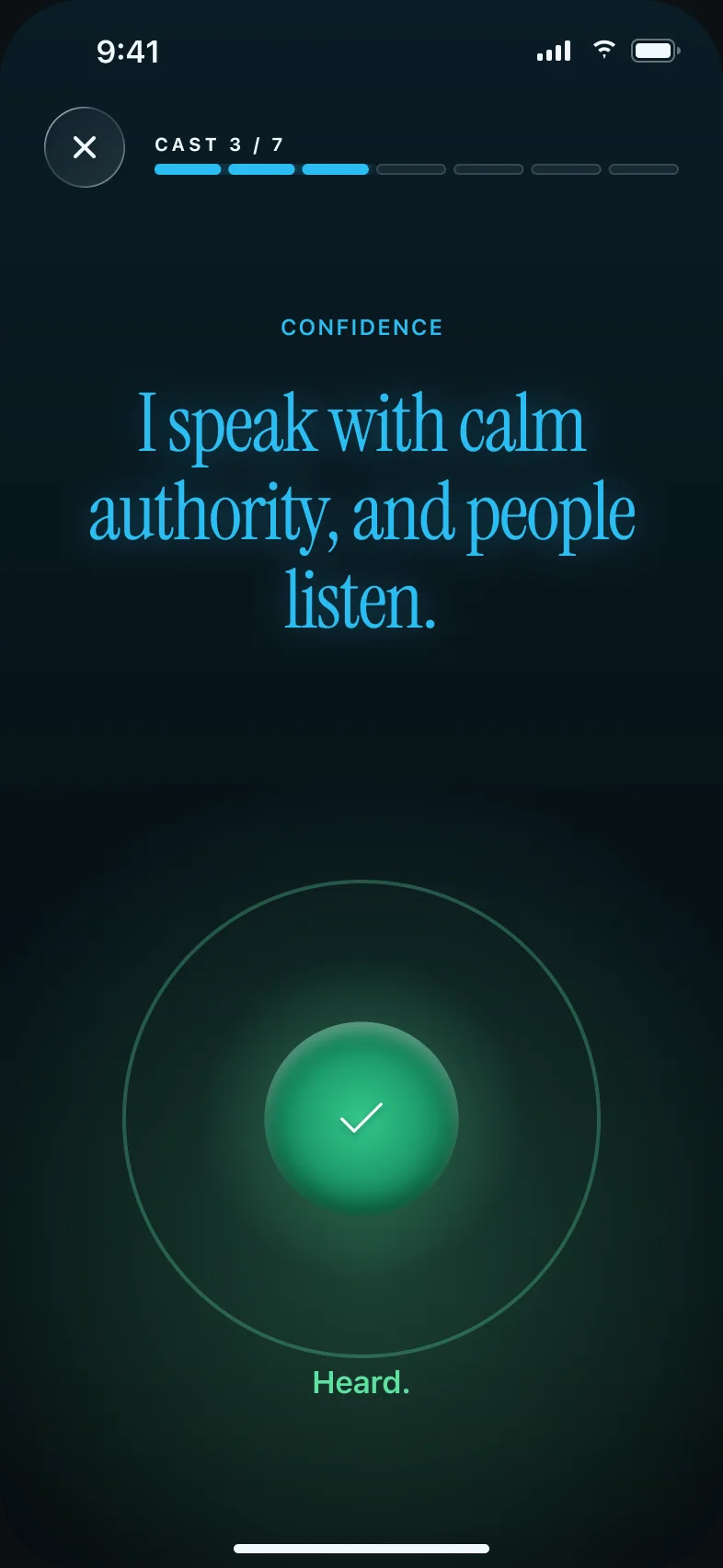
This is what Breakout is built to close. It is the first affirmations app that listens. You cast your spells out loud and on-device speech recognition verifies every word, so the line either got said or it did not. Rewire is where you shape your own rewrites, in your tense, in your words. Speak it, hear it, repeat it.
Get the grammar right, then get it out of your mouth. Only one of those two steps changes anything on its own.
The bottom line
Write your affirmations in the present tense. If the present tense feels like a lie, do not retreat into "I will," build a bridge instead: I am becoming, I am learning to, I choose. Keep "I will" for calendar items. And remember the ranking, because it is not close. Spoken and slightly clumsy beats silent and perfectly worded, every day of the week.
If you want the delivery technique next, how to say affirmations the right way covers it, and why affirmations work better out loud explains the mechanism.
Breakout is a personal development tool, not therapy or medical care.
Sources
- Hershfield, H. E., Goldstein, D. G., Sharpe, W. F., Fox, J., Yeykelis, L., Carstensen, L. L., & Bailenson, J. N. (2011). Increasing saving behavior through age-progressed renderings of the future self. Journal of Marketing Research, 48(SPL), S23-S37.
- Senay, I., Albarracín, D., & Noguchi, K. (2010). Motivating goal-directed behavior through introspective self-talk: The role of the interrogative form of simple future tense. Psychological Science, 21(4), 499-504.
- Wood, J. V., Perunovic, W. Q. E., & Lee, J. W. (2009). Positive self-statements: Power for some, peril for others. Psychological Science, 20(7), 860-866.
- MacLeod, C. M., Gopie, N., Hourihan, K. L., Neary, K. R., & Ozubko, J. D. (2010). The production effect: Delineation of a phenomenon. Journal of Experimental Psychology: Learning, Memory, and Cognition, 36(3), 671-685.
Keep reading: How to write affirmations that work · How do you say affirmations the right way? · Do you have to believe an affirmation for it to work? · Why do affirmations work better out loud?
Frequently asked
Should affirmations be in present or future tense?
Present tense, almost always. A present-tense affirmation describes who you are, which is what you are trying to change. Future tense describes an intention, which your mind can postpone indefinitely. Use a present-tense bridge like I am becoming or I am learning to when the plain present tense feels dishonest.
Why does future tense weaken an affirmation?
Because it hands the change to your future self, and research on future-self continuity shows people treat that person almost like a stranger. I will be confident is a promise made on someone else's behalf. I speak up when it matters is a description of you, today.
Is I am becoming present or future tense?
It is present tense, and that is why it works. I am becoming someone who speaks up describes something happening right now, so it does not trip your internal skeptic, and it does not park the change in a distant year.
Can I ever use I will in an affirmation?
Yes, for dated and external things. I will finish the draft by Friday is a plan, and plans belong in the future tense. Identity lines, the ones about who you are, work better in the present.
Does the tense matter more than saying it out loud?
No. Speaking is the bigger lever. Words spoken aloud are recalled roughly 10 to 25 percent better than the same words read silently. A perfectly worded affirmation read in your head is still a thought you had, not a thing you did.