How-to & getting started
Why do affirmations feel cringe?
Affirmations feel cringe because the line is further ahead of you than what you currently believe, and your brain flags the gap the moment it hears your own voice claim it. The discomfort is information, not a verdict. Shrink the gap, change the pronoun, and keep speaking. The cringe fades with repetition. Going silent to avoid it removes the only part that was working.

- Affirmations
- Getting started
Saying "I am confident" out loud, alone, in your own kitchen is one of the more uncomfortable things a reasonable adult can do. If you have tried it and immediately wanted to stop, you are not broken and the practice is not fake.
The cringe has a cause. The cause is fixable. And the fix is almost never the one people reach for, which is to say the lines quietly in their head instead.
Why do affirmations feel cringe?
Affirmations feel cringe because there is a gap between the sentence coming out of your mouth and the story you currently hold about yourself. Your brain notices the gap instantly. That flinch is the notice.
There is a second layer underneath it. Most adults have never deliberately said a sentence about themselves out loud. Not once. So the first time you do it, you are running two unfamiliar things at the same time: an unfamiliar claim and an unfamiliar act. It would be strange if that felt smooth.
Neither layer means the practice is nonsense. One means your line is too far ahead of you. The other means you are new at this. Both have fixes.
The cringe is data, not a verdict
There is real research behind the flinch. Wood, Perunovic and Lee (2009), published in Psychological Science, had 68 participants repeat "I am a lovable person" every 15 seconds for four minutes. People with high self-esteem felt slightly better afterward. People with low self-esteem felt worse than a control group that did nothing.
That study gets quoted as proof affirmations fail. It is not. It is proof that a grand line said by someone who does not believe it produces resistance, and the resistance is measurable. The participants were handed a sentence they could not accept, given no way to make it smaller, and told to repeat it.
So when a line makes you cringe, read it as a report on the line. Here is the translation table.
| What the cringe feels like | What it usually means | The fix |
|---|---|---|
| "This is just a lie" | The gap between the line and your current belief is too wide | Ladder it down until you can say it without flinching |
| "I feel stupid hearing my own voice" | Novelty, not falsity. You have never done this before | Keep going. This one fades on its own within a week or two |
| "Someone might hear me" | An environment problem wearing a psychology costume | Change the room, the car, the time. Never the method |
| "This sounds like a self-help person, not me" | Borrowed wording | Rewrite the line in the words you actually use |
| "I said it and felt worse afterward" | A grand claim colliding with low belief, the Wood 2009 pattern | Go smaller and more specific. Rebuild from something true |
Fix one: shrink the line until it stops lying
The strongest single move is to stop trying to say the finished sentence.
"I am confident in every room" is a destination. "I can handle one uncomfortable conversation today" is a step. The second one does not cringe, because it is not making a claim you would have to defend.
Pick the version of the line you would rate about a six or seven out of ten on believability. Not a two, which produces the flinch. Not a ten, which changes nothing. Then raise it as the ground under you moves. Whether you have to believe an affirmation for it to work walks the full ladder, and how to write affirmations that work covers the wording.
Fix two: change the pronoun
This one is small and it works.
Kross and colleagues (2014), across seven studies with 585 participants, found that the pronoun you use when talking to yourself changes how the sentence lands. Referring to yourself in the second or third person, using "you" or your own name instead of "I", created enough psychological distance to reduce distress under social stress. It worked even for socially anxious participants, and it did so without requiring visible mental effort.
Applied here: if "I am someone who follows through" makes you wince, try "you are someone who follows through," or put your own first name in front of it. The claim is identical. The delivery is not. Saying it to yourself, rather than as yourself, gives the sentence somewhere to land that is not directly on top of your self-image.
Use it as a bridge. Most people move back to "I" within a few weeks, once the line stops feeling borrowed.
Fix three: say it anyway, on purpose
The uncomfortable truth is that some of the cringe just needs reps. Not because you are forcing belief, but because your voice saying things about you is a new category of experience and new categories feel strange until they do not.
Lally and colleagues (2010) tracked real habits and found behaviours became automatic after a median of 66 days, with a range of 18 to 254. Awkwardness follows a faster curve than automaticity. For most people the sharp edge is gone inside two weeks. What remains after that is the flat stretch around weeks four to eight, where it does not feel awkward and does not feel dramatic either. That stretch is not failure. It is the groove being carved. How long affirmations take to work has the honest timeline.
Why you cannot fix the cringe by going silent
Here is where most people quietly abandon the practice without noticing. The lines feel awkward out loud, so they start saying them in their head instead. The cringe disappears. So does the effect.
MacLeod and colleagues (2010) documented the production effect: words spoken aloud are recalled roughly 10 to 25 percent better than words read silently, across repeated experiments. Speaking recruits more of you. Your mouth, your ears, your own voice as evidence. A read affirmation is a thought you had. A spoken one is a thing that happened.
The comfort of silence is the tell. Silent reading feels fine precisely because nothing is being claimed and nothing can be checked. That is also why it changes nothing. Why affirmations work better out loud goes deeper on the mechanism.
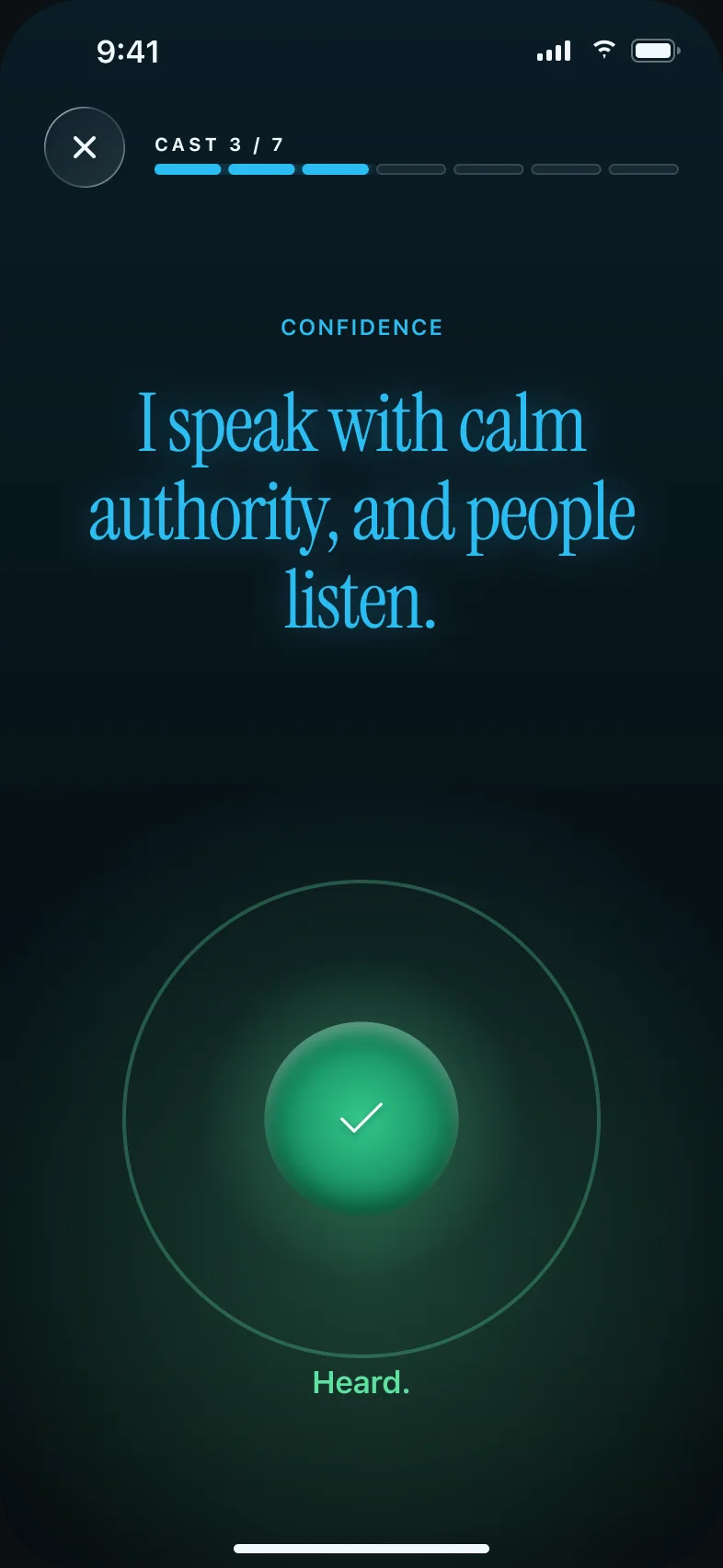
This is the whole reason Breakout is built the way it is. It is the first affirmations app that listens. You cast your spells out loud and on-device speech recognition verifies every word, so a session is either cast or it is not. There is no version where you skim the list and count it.
That sounds like it would make the cringe worse. It does the opposite. Having something on the other end turns an odd private ritual into a practice with a scoreboard, and a practice with a scoreboard is much harder to talk yourself out of on day nine.
What to do this week
Four moves, in order.
- Cut your list to three lines. Long lists amplify the awkwardness and dilute the focus.
- Ladder each line down until you can say it without flinching. Six or seven out of ten on believability.
- Pick a private venue and a fixed time. Car, shower, kitchen before anyone is up.
- Say all three out loud, every day, for two weeks before you judge any of it.
If a line still makes you flinch on day fourteen, that is not a failure of nerve. That line is wrong for now. Replace it, do not abandon the practice. And if the discomfort is heavier than awkwardness, if speaking well of yourself brings up something sharper, that is worth talking through with a professional rather than repeating over.
The bottom line
Cringe means the line is running ahead of your belief, or that speaking about yourself is new. Both are early-stage problems, not permanent ones. Make the line smaller, borrow a pronoun, use a room where nobody can hear you, and keep going for two weeks.
The one thing not to do is retreat into your head to make it comfortable. Comfortable is what reading always was. Speaking is the part that changes anything.
Breakout is a personal development tool, not therapy or medical care.
Sources
- Wood, J. V., Perunovic, W. Q. E., & Lee, J. W. (2009). Positive self-statements: Power for some, peril for others. Psychological Science, 20(7), 860-866.
- Kross, E., Bruehlman-Senecal, E., Park, J., Burson, A., Dougherty, A., Shablack, H., Bremner, R., Moser, J., & Ayduk, O. (2014). Self-talk as a regulatory mechanism: How you do it matters. Journal of Personality and Social Psychology, 106(2), 304-324.
- MacLeod, C. M., Gopie, N., Hourihan, K. L., Neary, K. R., & Ozubko, J. D. (2010). The production effect: Delineation of a phenomenon. Journal of Experimental Psychology: Learning, Memory, and Cognition, 36(3), 671-685.
- Lally, P., van Jaarsveld, C. H. M., Potts, H. W. W., & Wardle, J. (2010). How are habits formed: Modelling habit formation in the real world. European Journal of Social Psychology, 40(6), 998-1009.
Keep reading: Do you have to believe an affirmation for it to work? · Can affirmations backfire and make you feel worse? · Why do affirmations work better out loud? · How to write affirmations that work
Frequently asked
Why do affirmations feel fake when I say them?
Because the line claims something your current self-story does not support yet, and hearing your own voice say it makes the mismatch obvious. That is a signal to make the line smaller and more believable, not a signal to stop. A line you half believe today is the one that moves.
Is it normal to feel stupid saying affirmations out loud?
Yes, and it is close to universal in the first week. Most adults have never said a sentence about themselves out loud on purpose. The discomfort is novelty, not falsity. It drops sharply once speaking becomes routine rather than an event.
Should I stop saying affirmations if they feel cringe?
No. Change the line, not the method. Ladder it down to something you can say without flinching, then rebuild upward. Quitting because it felt awkward removes the mechanism. Speaking is the part that does the work.
Does saying affirmations silently avoid the cringe?
It does, and that is the problem. Silent reading is comfortable because nothing is being claimed. Spoken words are recalled better than words read silently, and a silent practice cannot be verified, so it quietly becomes nothing.
How long until affirmations stop feeling awkward?
For most people the sharpest discomfort fades within one to two weeks of daily practice. Full automaticity takes longer. Habit research puts the median at 66 days with a wide range, so treat weeks four to eight as the flat stretch rather than a verdict.